When planning a warehouse racking project, most buyers focus on load capacity, layout, and aisle width.
However, one decision that is often underestimated is the surface finish of the steel structure.
In real projects, choosing the wrong coating can lead to early corrosion, frequent maintenance, and even safety concerns.
This article explains, in practical terms, the difference between electro galvanized and hot-dip galvanized finishes for warehouse racks, and how to choose the right option based on real operating conditions.
Why the Coating Choice Matters in Real Warehouse Projects
In many projects we have seen, racking systems were installed correctly, but the coating selection did not match the site environment.
- Rust appearing within a few years in humid or coastal areas
- Discoloration and surface damage caused by regular wash-down cleaning
- Unexpected repair and replacement costs
The finish itself does not change the structural capacity of a rack, but it has a direct impact on service life, maintenance cost, and long-term reliability.
This is why understanding the real difference between electro galvanized and hot-dip galvanized finishes is important before placing an order.
What Is Electro Galvanized for Warehouse Racks?
Electro galvanized (also called electroplated zinc) coating is produced by applying a thin layer of zinc onto the steel surface using an electrical process.
- A smooth and clean surface
- Uniform appearance
- Good basic corrosion protection in controlled environments
Because the zinc layer is relatively thin, electro galvanized racks are mainly used in:
- Dry indoor warehouses
- Distribution centers with stable temperature and humidity
- Retail back-of-house storage areas
Electro galvanized finishes are often selected when appearance is important and the operating environment is not aggressive.
What Is Hot-Dip Galvanized for Warehouse Racks?
Hot-dip galvanized coating is created by fully immersing the fabricated steel components into molten zinc.
This process forms a much thicker and more robust zinc layer that bonds metallurgically with the steel.
For warehouse racking systems, hot-dip galvanized finishes are typically chosen when:
- Higher corrosion resistance is required
- The racks are exposed to moisture, weather, or industrial air
- Long service life is a key project requirement
Typical applications include:
- Outdoor or semi-outdoor storage areas
- Loading yard storage racks
- Warehouses near ports or coastal regions
- Projects in high-humidity or high-temperature environments
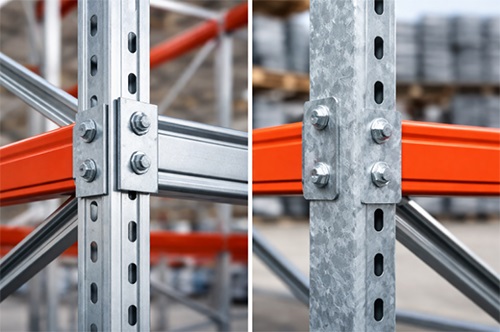
The surface is usually slightly rougher and less uniform compared with electro galvanized finishes, but performance is significantly stronger.
Electro Galvanized vs Hot-Dip Galvanized: Key Differences
| Item | Electro Galvanized | Hot-Dip Galvanized |
|---|---|---|
| Coating process | Zinc is applied by electroplating | Steel is immersed in molten zinc |
| Coating thickness | Thin zinc layer | Much thicker zinc layer |
| Corrosion resistance | Moderate | High |
| Surface appearance | Smooth and uniform | Rough zinc texture |
| Typical use | Indoor dry environments | Outdoor humid environments |
| Durability | Standard warehouses | Harsh conditions |
Performance in Real Warehouse Environments
In a standard dry indoor warehouse, electro galvanized racks usually perform well for many years without visible corrosion.
However, when the environment changes, performance differences become obvious.
In cold storage facilities, food warehouses with frequent wash-down, or buildings with high condensation levels, moisture remains on steel surfaces for long periods.
In these cases, electro galvanized coatings may start to show corrosion much earlier.
In port logistics centers, coastal areas, or industrial zones, airborne salt and pollutants accelerate corrosion.
Here, hot-dip galvanized racks provide a much higher safety margin.
High temperatures, strong sunlight, sand, dust, and coastal humidity require stronger corrosion protection. Hot-dip galvanized is usually the safer option for semi-outdoor applications.
Cost vs Lifecycle Value
From a purchasing point of view, electro galvanized racks usually have a lower initial cost.
Hot-dip galvanized racks require additional processing and handling, so the unit price is normally higher.
However, the real comparison should be made over the full lifecycle of the racking system:
- How often will maintenance be required?
- Will any components need early replacement due to corrosion?
- Could corrosion affect safety inspections or insurance requirements?
In harsh environments, the higher initial cost of hot-dip galvanized racks is often offset by longer service life and lower maintenance risk.
For standard indoor warehouses, electro galvanized racks remain a cost-effective and practical solution.
Which Finish Is Better for Different Rack Types?
Most indoor pallet racking installations work well with electro galvanized finishes.
For outdoor or covered-yard storage, hot-dip galvanized is preferred.
Shelving systems
Light-duty and medium-duty shelving used indoors usually adopts electro galvanized finishes.
Cantilever racks are often used outdoors for long materials such as pipes or timber.
Hot-dip galvanized is commonly selected.
Mezzanine structures
Indoor mezzanine floors usually use electro galvanized finishes.
For humid or semi-open buildings, hot-dip galvanizing is recommended.
Outdoor storage racks
Fully exposed racks should use hot-dip galvanized coating for maximum durability.
Common Mistakes When Selecting Galvanized Warehouse Racks
- Selecting based on price only without reviewing environment
- Ignoring humidity, condensation, or cleaning conditions
- Underestimating forklift impact on surface protection
- Deciding coating too late after design is finalized
How to Choose the Right Galvanized Finish for Your Project
- Is the rack installed indoors or outdoors?
- Is there frequent wash-down or condensation?
- Is the site near coastal or industrial areas?
- What service life is expected?
- Is cost or durability more important?
If the warehouse is dry and fully enclosed, electro galvanized is usually sufficient.
If risk factors exist, hot-dip galvanized should be considered.
Galvanized Warehouse Rack Solutions from Aceally
Aceally is a China-based warehouse racking manufacturer with over 20 years of experience.
We supply both electro galvanized and hot-dip galvanized finishes for pallet racking, shelving, cantilever racks, and mezzanine systems.
Our engineering team supports global clients by evaluating site conditions and recommending suitable corrosion protection during the design stage.
Quality Standards and Inspection for Galvanized Racks
- Zinc coating thickness testing
- Surface continuity inspection
- Adhesion and coating integrity checks
International standards such as ISO and ASTM are commonly referenced depending on project requirements.
Conclusion
Electro galvanized and hot-dip galvanized finishes both play important roles in warehouse racking systems.
Electro galvanized is best for clean, dry indoor environments.
Hot-dip galvanized is designed for outdoor, humid, and demanding conditions.
The best choice depends on real operating conditions rather than price alone. A correct coating decision at the early stage significantly improves long-term safety and performance.