Pallet racking systems are widely used in warehouses, distribution centers, and manufacturing facilities. During daily operations, forklifts and other material handling equipment move pallets in and out of rack bays. Even when operators follow standard procedures, accidental contact between forklifts and rack columns can occur.
Pallet rack upright protectors are designed to reduce the risk of damage to these structural components. They are installed around the lower sections of rack uprights, where collisions are more likely to happen. Choosing the correct protector and installing it properly can help maintain the condition of the racking system and reduce maintenance costs.
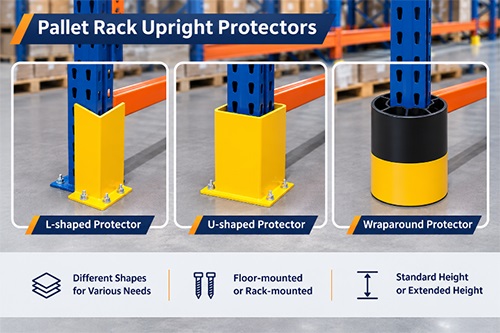
Upright protectors help reduce forklift impact damage, but their effectiveness depends on the protector design, installation method, and actual warehouse conditions.
1. Why Upright Protection Matters
A pallet rack upright is a key vertical component that transfers loads from the beams and stored pallets to the floor. It works together with bracing, base plates, anchors, and other frame components to form a stable structure.
The lower part of an upright is particularly exposed to forklift traffic. A direct impact can cause local deformation, bending, or damage around the base plate and anchor area. Depending on the severity and location of the impact, this damage may affect the structural performance of the rack frame.
An upright protector acts as a physical barrier between the forklift and the rack column. It is intended to absorb or deflect some of the impact energy before it reaches the upright.
Actual protective performance depends on the material, thickness, shape, fixing method, and impact conditions. Upright protectors can reduce the risk of damage, but they cannot prevent every type of collision.
2. Common Types of Pallet Rack Upright Protectors
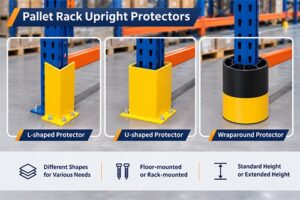
Pallet rack upright protectors are available in different shapes, installation methods, and heights. These characteristics are often combined in a single product.
By Shape
| Protector Type | Main Features | Typical Application |
|---|---|---|
| L-shaped Upright Protector | Covers an exposed corner or two adjacent sides of a rack column. | Rack ends and exposed upright corners. |
| U-shaped Upright Protector | Wraps around three sides of the upright. | Locations where impacts may occur from different directions. |
| Wraparound Protector | Provides protection around a larger portion of the upright profile. | Exposed columns requiring broader coverage. |
By Installation Method
Floor-Mounted Protectors
These protectors are anchored directly to the concrete floor, independently of the rack upright. They are commonly used in forklift traffic areas and at exposed rack ends.
Rack-Mounted Protectors
These are attached directly to the racking structure using a fixing arrangement approved for the rack system. Their suitability depends on the upright design, connection details, and expected impact conditions.
Floor-mounted and rack-mounted protectors transfer impact forces differently. The installation method should be considered as part of the overall protection design.
By Protection Height
Standard-height protectors cover the lower section of a rack upright, while extended-height protectors protect a greater vertical area.
The appropriate height depends on the likely impact zone and the type of material handling equipment used.
3. Materials and Structural Design
Upright protectors are commonly manufactured from formed steel plate. Steel thickness, bending geometry, and reinforcement design influence rigidity and resistance to deformation.
Some protectors use a simple folded steel plate, while others include reinforced sections or a wider base. The design should provide sufficient clearance around the upright and should not interfere with rack beams, bracing, base plates, or pallet handling.
Powder coating is commonly used for indoor warehouse applications. Galvanized finishes may be considered where greater exposure to moisture is expected.
Buyers should confirm the actual material thickness, dimensions, fixing details, and surface finish rather than comparing products by appearance alone.
Technical Note: A thicker steel plate does not necessarily mean better protection in every situation. The complete design, including how impact forces are absorbed and transferred, is equally important.
4. Where Should Upright Protectors Be Installed?
Upright protectors are commonly installed at:
- Rack end frames beside forklift travel routes.
- Uprights at the entrances of narrow aisles.
- Rack columns near loading and unloading areas.
- Exposed corners where forklifts frequently turn.
- Areas with limited maneuvering space or high vehicle traffic.
Not every upright necessarily requires the same type of protection. A warehouse risk assessment can help identify the locations where impact protection is most necessary.
The need for upright protection also depends on applicable local safety requirements, forklift traffic, rack exposure, and the warehouse layout.
In areas with frequent vehicle movement, a combination of upright protectors and other impact protection barriers may be appropriate.
5. How to Choose the Right Upright Protector
Before placing an order, buyers should check the following technical details:
| Selection Item | Information to Confirm | Why It Matters |
|---|---|---|
| Upright Dimensions | Width, depth, and profile of the rack column. | Confirms that the protector fits the upright. |
| Protector Height | Overall height and lower section to be covered. | Should match the likely impact area. |
| Steel Thickness | Actual plate thickness and construction details. | Helps buyers compare product construction. |
| Fixing Method | Floor-mounted, rack-mounted, or another specified method. | Affects installation and impact load transfer. |
| Anchor Requirements | Anchor type, size, embedment, and concrete floor suitability. | Confirms compatibility with the floor. |
| Surface Finish | Powder coating, galvanizing, or another finish. | Should suit the warehouse environment. |
| Installation Clearance | Space around the rack and forklift travel path. | Helps prevent obstruction during pallet handling. |
Providing photographs, rack upright dimensions, and installation drawings to the manufacturer can help avoid compatibility problems.
For floor-mounted protectors, the concrete slab must be suitable for the specified anchors and expected forces.
For rack-mounted designs, compatibility with the racking system should be confirmed before installation. Drilling additional holes or modifying rack uprights without the rack manufacturer’s approval should be avoided, as such changes may affect structural performance.
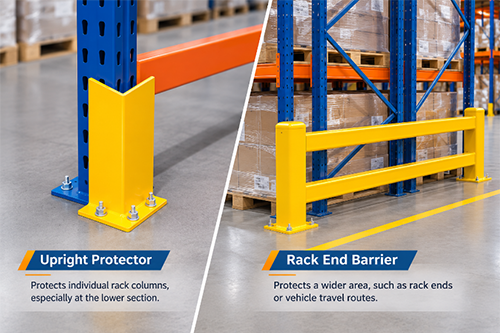
6. Upright Protectors vs. Rack End Barriers
Upright protectors and rack end barriers are both used to reduce the risk of forklift impact damage, but they serve different purposes.
Upright Protectors
These are designed to protect individual rack columns, particularly around the lower sections where accidental contact is more likely.
Rack End Barriers
Rack end barriers, including guardrails and other protective barriers, are used to protect a wider area along exposed rack ends or vehicle travel routes.
In busy warehouses, rack end barriers may provide a more suitable protective arrangement where forklifts frequently turn or travel close to the ends of racking rows.
The two solutions are not necessarily interchangeable. The choice depends on the direction of possible impacts, traffic patterns, available space, and the level of protection required.
7. Installation, Inspection and Maintenance
Correct installation is essential for upright protectors to perform as intended.
Floor-mounted protectors should be installed using the specified anchors and fixing arrangement. The installer should check the concrete condition, anchor positioning, and required clearances before installation.
Rack-mounted protectors must be compatible with the upright profile and should follow the rack manufacturer’s installation requirements.
Once installed, upright protectors should be included in routine warehouse safety inspections.
Inspection Checklist
- Loose or damaged anchors.
- Cracked welds.
- Severe deformation or bending.
- Corrosion or damaged surface finishes.
- Movement around the fixing points.
- Signs of impact damage to the rack upright itself.
A damaged protector should not automatically be considered effective simply because it remains in place. It should be assessed and repaired or replaced when necessary.
Safety Note: Upright protectors do not increase the load capacity of pallet racking. If a rack upright has been struck, the affected frame should be inspected by a competent person, and damaged components should be handled according to the rack manufacturer’s guidance and applicable safety requirements.
Conclusion
Pallet rack upright protectors provide an additional physical barrier against forklift impacts, particularly around exposed rack columns and high-traffic areas. Their effectiveness depends on selecting a suitable design, confirming the fixing method, and installing them correctly.
For warehouse operators and racking buyers, the key is to match the protector to the upright profile, impact exposure, and floor conditions rather than selecting a product based on appearance alone.
Find the Right Pallet Rack Upright Protectors
Looking for upright protectors that match your existing pallet racking system?
Share your rack upright dimensions, preferred protector height, installation method, and warehouse conditions with Aceally. Our team can review your requirements and discuss suitable protector configurations for your project.