SHELVING SELECTION GUIDE
Choosing medium duty shelving starts with the goods you handle every day. Carton dimensions, weight and picking frequency will tell you more about the configuration you need than the size of the shelving alone.
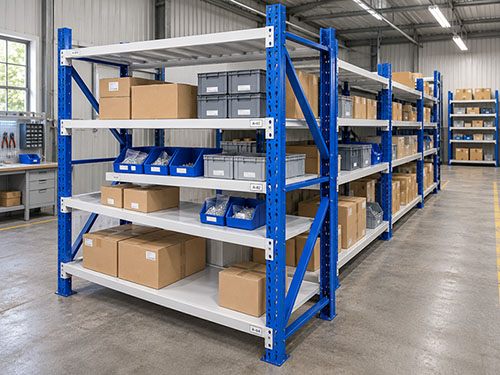
Butterfly hole shelving allows shelf levels to be repositioned along the uprights as stock changes. But adjustable shelves still need to be planned carefully: too little clearance makes cartons difficult to remove, while excessive depth can leave frequently needed items out of reach.
1. Set Shelf Heights Around Your Goods
Measure your tallest cartons and storage bins before deciding on shelf spacing. Include lids, handles or packaging that extends above the main container.
As an initial layout allowance, leave around 50–100 mm above regularly handled cartons, then check whether staff can comfortably grip, lift and remove them. Containers that need to tilt during removal may require additional clearance.
PLANNING EXAMPLE
A carton measuring 350 mm high may suit a clear opening of approximately 400–450 mm, depending on how it is handled. Measure from the shelf surface to the underside of the structure above; beam spacing alone does not represent usable clearance.
Not every level needs the same spacing. Smaller containers can occupy shorter openings, while taller cartons need more room. Keep frequently picked goods within comfortable reach, with heavier items on lower levels and lighter, less frequently used stock higher up.
2. Choose Shelf Depth for Easy Access
A 600 mm shelf depth can accommodate many cartons and storage containers. However, extra depth is useful only if staff can reach the goods without repeatedly moving other items.
Two cartons measuring 280 mm deep occupy 560 mm from front to back. They may fit within a 600 mm usable shelf depth, but you still need to check the available space and how easily the rear carton can be retrieved.
Confirm the usable deck depth, rather than relying only on the shelving’s overall dimensions. Uprights and other structural components may affect the storage space available.
- Frequent picking: A single row of cartons is often easier to manage when access is from one side.
- Reserve stock: Two rows of the same item can work, provided the arrangement suits your replenishment routine.
Avoid placing different, frequently picked products behind one another. The rear location may appear efficient on a layout drawing but become inconvenient during daily use.
3. Compare Load Capacity and Configuration
Shelf dimensions alone do not tell you how much a unit can hold. Shelving with the same overall size may use different upright profiles, beams and deck panels.
Aceally offers the following four-level butterfly hole shelving configurations, listed at L2000 × D600 × H2000 mm:
| Rated Load per Level | Upright Profile | Beam Profile | Steel Deck Thickness |
|---|---|---|---|
| 200 kg | 80 × 50 × 0.7 mm | 60 × 40 × 0.6 mm | 0.4 mm |
| 300 kg | 80 × 50 × 1.0 mm | 60 × 40 × 1.0 mm | 0.4 mm |
| 500 kg | 80 × 50 × 1.2 mm | 80 × 40 × 1.2 mm | 0.5 mm |
Confirm whether the listed dimensions describe the overall unit or usable storage space. Load ratings apply to the specified configuration and approved loading conditions.
LOAD CALCULATION EXAMPLE
Eight cartons weighing 30 kg each create a total load of 240 kg, so the 200 kg option is unsuitable. The 300 kg configuration may be suitable, subject to the manufacturer’s approved loading conditions and total bay capacity. Include the weight of cartons, bins and other containers in your calculation.
Dense metal components need particular attention. A compact container can place substantial weight on a small area, even when the total weight remains below the stated level rating.
Compare the complete, load-rated configuration rather than judging capacity from steel thickness alone. Confirm:
- Whether the rating applies to a uniformly distributed load.
- The maximum permitted load for the complete bay.
- Any restrictions on concentrated loads.
- Whether changes to shelf positions or dimensions affect the rating.
4. Arrange Locations Around Your Picking Routine
Once the dimensions and capacity are selected, give each product a defined storage location.
Use a simple bay-and-level code on shelf labels, and match it to your inventory records. Staff should be able to identify where an item belongs without opening several cartons or searching through mixed stock.
If the same product occupies both front and rear positions, keep that arrangement consistent during replenishment. Mixing products in a deep location makes picking and stock checks more difficult.
Distribute goods according to the approved loading arrangement. Keep access routes clear, and check that beam connectors and any required locking devices are correctly installed before loading.
It also helps to try a representative carton or bin in the proposed layout. A configuration that looks suitable on paper may need adjustment once someone actually reaches in, lifts the container and puts it back.
Before Requesting a Quotation
Prepare these details before comparing shelving options:
- Carton or bin dimensions, including the largest items.
- Maximum expected weight per level, including containers.
- Available installation space and access routes.
- Required number of levels.
- Picking frequency and whether access is needed from one or both sides.
These details give Aceally a clearer basis for recommending shelf spacing, depth and a suitable load-rated configuration. They also make quotations easier to compare, because each supplier is working from the same storage requirements.