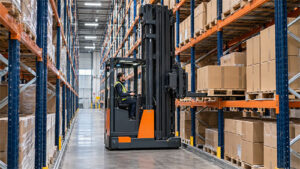
A 3-way forklift can handle pallets to the left, right, and front while keeping the truck body aligned with the aisle.
Often called a turret truck, this type of equipment is used in very narrow aisle (VNA) storage systems. Its rotating and traversing fork assembly allows access to side-facing pallet locations without the whole truck making a right-angle turn inside the storage aisle.
The potential benefit is higher storage density. However, a successful installation depends on more than aisle width: pallet dimensions, capacity at height, floor conditions, guidance, and material flow must work together.
Before selecting a 3-way forklift, confirm:
- The required operating aisle and end-of-aisle transfer space.
- Residual capacity at the highest required storage level.
- Floor suitability and the intended guidance arrangement.
- Pallet compatibility, replenishment flow, and total project cost.
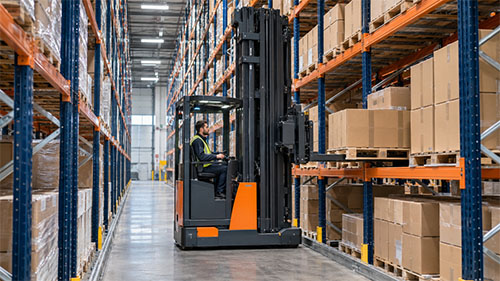
How Does a 3-Way Forklift Work?
A turret attachment rotates and moves the forks across the front of the truck. This enables pallet handling on either side of the aisle while the chassis remains aligned with the aisle.
Because the vehicle does not need the same right-angle stacking maneuver as a conventional reach truck, the storage layout may use narrower working aisles. The amount of space saved depends on the selected equipment and the actual load dimensions.
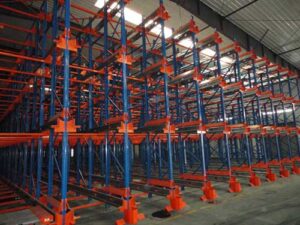
To use this space effectively, the truck and very narrow aisle pallet racking should be planned together. Confirm operating clearances, pallet positions, guidance, and access before finalizing the rack layout.
3-Way Forklift vs. Conventional Reach Truck
Both types can serve indoor pallet storage, but their handling movements and layout requirements differ. The comparison below refers to conventional reach trucks, rather than specialized multidirectional models.
| Planning Factor | 3-Way / Turret Truck | Conventional Reach Truck |
|---|---|---|
| Side-facing pallet locations | The turret assembly handles the load while the chassis remains aligned with the aisle. | The truck normally turns to face the location before using its reach mechanism. |
| Aisle design | Based on the truck, turret movement, load envelope, guidance, and operating clearances. | Based on right-angle stacking requirements, load dimensions, and maneuvering clearances. |
| Guidance | Often uses mechanical rail or inductive wire guidance in working aisles. | Commonly operates with free steering. |
| Main planning advantage | Supports layouts focused on very narrow aisles and high storage density. | Offers flexibility across suitable pallet storage and transport tasks. |
| Selection priority | Evaluate the complete VNA system, including floor, guidance, and pallet transfer. | Evaluate stacking space, travel routes, capacity, and handling flexibility. |
Neither option is automatically more productive. Compare both against the same pallet sizes, storage heights, peak workload, and travel routes.
How Much Aisle Space Does a 3-Way Forklift Need?
There is no single aisle width suitable for every 3-way forklift. A dimension quoted for one truck and pallet configuration should not be transferred directly to another project.
Ask the equipment supplier to verify the operating aisle using the actual pallet and load envelope. Include any goods projecting beyond the pallet, as well as guidance components and the required clearances.
- Pallet and load dimensions:
Check the largest permitted load, not just the nominal pallet size. - Clearance boundaries:
Identify exactly where the aisle measurement is taken. - Guidance arrangement:
Include rail geometry or wire-guidance requirements in the layout. - End-of-aisle space:
Allow for entering, leaving, changing aisles, and transferring pallets.
Planning tip:
finalize the rack layout only after the truck supplier has confirmed the operating dimensions and clearances for the proposed configuration.
Check Residual Capacity at the Required Lift Height
Nominal lifting capacity does not confirm what a truck can handle at every height and load center. The approved capacity may vary with lift height, mast configuration, attachment, and load position.
For example, a nominal 1,600 kg rating alone does not establish that the truck can place a 1,600 kg pallet at your highest storage level. Use the capacity chart for the exact truck configuration.
- Maximum palletized load weight, including the pallet and packaging.
- Load dimensions, center of gravity, and specified load center.
- Required fork height for placing and retrieving the load.
- Capacity with the proposed mast, turret attachment, and forks.
Provide the supplier with your heaviest loads and highest required handling positions, then request confirmation that the selected configuration covers those operating conditions.
Confirm Floor Suitability and Guidance Requirements
High-level VNA operation requires a floor suited to the selected truck and its operating conditions. A surface that looks level may still need measurement or remediation.
Floor Assessment
Assess floor geometry along the intended wheel paths, slab capacity under concentrated wheel loads, and the condition of joints and transitions. Include any proposed guidance installation in the assessment.
European VNA planning guidance references documents such as FEM 4.103-1 / FEM 10.2.14-1. Confirm the applicable specification, edition, and measurement method with the truck supplier and project specialists rather than applying a general flatness figure.
Rail Guidance
Mechanical guidance uses aisle rails and compatible truck guide rollers to maintain alignment. Rail positions and profiles must be coordinated with the truck, racking, and lowest storage positions.
Wire Guidance
Inductive guidance uses a signal from a wire installed in the floor. Compatible truck sensors use that signal to help maintain lateral alignment along the guided aisle.
Guidance is not the same as automation.
Rail or wire guidance does not by itself make the truck driverless or automate pallet handling. Personnel access and operating procedures must also be addressed in the project design.
Compare Storage Density with Total Operating Cost
More pallet positions can make a VNA layout attractive, but storage capacity is only one part of the decision. Check whether the complete system can meet your handling workload at an acceptable total cost.
- Infrastructure:
Allow for floor surveys, any required remediation, and guidance installation. - Pallet supply:
Define how inbound and outbound loads reach the aisle transfer points. - Throughput:
Assess peak pallet movements, travel distances, lifting tasks, and aisle changes. - Support:
Include operator training, charging arrangements, maintenance, and downtime planning. - Operating environment:
Confirm any cold-store or other special configuration with the manufacturer.
Where automated pallet handling is also being considered, explore the AGV forklift range as a separate equipment option. Automation and three-way handling are different capabilities; verify each model’s handling functions, aisle requirements, and lifting capacity.
What Information Should You Prepare?
Give the truck and racking suppliers the same project information so their proposals can be checked against a shared layout and operating plan.
| Information | Details to Provide |
|---|---|
| Pallets and loads | Pallet construction, entry openings, load dimensions, maximum weight, and any overhang. |
| Storage layout | Rack arrangement, storage levels, clear height, obstructions, and transfer areas. |
| Floor information | Available surveys, slab information, joints, damage, and proposed guidance routes. |
| Workload | Peak movements per hour, shifts, typical travel routes, and replenishment arrangements. |
| Site conditions | Temperature, pedestrian access arrangements, charging facilities, and service access. |
Frequently Asked Questions
Is a 3-way forklift the same as an AGV forklift?
No. “3-way” describes the load-handling capability, while “AGV” describes automated guidance and operation. A turret truck is not necessarily driverless, and an AGV forklift does not necessarily have a turret attachment.
Can an existing warehouse be converted to VNA storage?
It may be possible after checking the floor, building clearances, rack configuration, truck access, and pallet flow. Include the cost and disruption of any required modifications when assessing the conversion.
Does a higher lift height mean the same load can be handled?
Not necessarily. Check the approved capacity chart for the exact truck configuration, lift height, load center, and attachment. A nominal rating alone is insufficient for selecting a high-level handling system.
Should the forklift or the racking be selected first?
Develop both together. The rack layout defines storage positions and access requirements, while the truck determines handling clearances, capacity at height, and guidance needs. Confirm their compatibility before ordering.
Plan the Complete Storage System
A 3-way forklift is worth considering when storage density is a priority and the site can support VNA operation. Its value depends on matching the truck to the loads, floor, racking, and daily handling workload.
For an Aceally warehouse racking project, use a coordinated layout showing pallet positions, operating aisles, and transfer areas as the basis for discussions with the equipment supplier. Resolve capacity and clearance requirements before committing to the final design.