Warehouse logistics managers, industrial facility contractors, and global rack importers need to consider more than load capacity when selecting a heavy-duty pallet racking manufacturer. The right system must provide reliable structural performance, meet applicable safety requirements, and remain suitable for the warehouse environment and operating conditions.
Partnering with a specialized factory-direct manufacturer such as Aceally (Xiamen) Technology Co., Ltd. (Aceally Group), which offers CE- and AS4084-certified heavy-duty pallet racking, allows warehouse buyers to source structural steel storage systems tailored to regional requirements while working directly with the manufacturer.
For international warehouse projects, evaluating a heavy-duty pallet racking supplier across several practical areas can help buyers reduce structural, quality, and delivery risks.
Drawing from 30 years of manufacturing experience in industrial storage systems, Aceally Group highlights four key areas for warehouse procurement teams to consider:
- Structural Steel Grade and Load Engineering: Utilizing prime Q235B structural steel, cold-formed profiles, and load-bearing calculations for heavy-duty storage applications.
- Global Regulatory Certification and Compliance: Supporting requirements related to Australian AS4084, European CE, ISO 9001 quality management, and other international engineering guidelines.
- Seven-Step Surface Protection Workflow: Applying a controlled process covering pretreatment, protective coating, quality testing, and export packaging.
- Factory Execution and Manufacturing Scale: Operating 150,000 square meters of manufacturing space across four production facilities equipped with automated roll-forming lines and robotic welding.
Q235B Structural Steel Engineering and Load-Bearing Capacity
The structural performance of a heavy-duty pallet rack starts with the quality of its raw materials and the engineering of its profiles. Steel grade, profile design, beam capacity, and upright strength all influence how a rack performs under heavy pallet loads and daily forklift operation.
Aceally Group manufactures heavy-duty pallet racking systems using Q235B structural steel. Cold-formed upright columns and box beams undergo precision roll-forming to create rigid structural profiles for multi-tier warehouse storage applications.
Engineering teams evaluate beam deflection limits, upright column buckling factors, and load distribution across individual racking layouts. Each beam-to-column connection uses heavy-duty connector hooks and safety locking pins to help prevent accidental beam dislodgement during forklift operation.
Heavy-duty baseplates anchor upright frames to concrete warehouse floors using expansion bolts, providing additional stability during dynamic loading, forklift impacts, and other operating conditions. For buyers, these engineering details are important because rack capacity should be based on the complete structural system rather than steel grade alone.
Regulatory Certification: CE, AS4084, and International Engineering Standards
Regulatory compliance is an important consideration when purchasing warehouse racking for international projects. Different markets and projects may require different technical standards, certifications, and engineering documentation.
Aceally Group manufactures storage solutions under an ISO 9001-certified quality management framework, with CE certification, Australian AS4084 compliance, and proprietary design patents. These credentials provide buyers with a clear reference when evaluating manufacturing quality, structural design, and product compliance.
For projects serving different international markets, Aceally’s structural calculations can also incorporate established regional references, including American RMI guidelines, European FEM codes, and OSHA safety requirements.
For warehouse owners, logistics contractors, and regional distributors, having access to the relevant technical and compliance documentation can simplify project review and help ensure that the selected racking system is appropriate for the destination market and application.
Selective Racking vs High-Density Systems: Access Strategy and Layout Selection
Selecting the right racking configuration depends on balancing storage density, pallet accessibility, inventory turnover, and available warehouse space. A capable heavy-duty pallet racking manufacturer should be able to support different storage requirements rather than offering only one standard configuration.
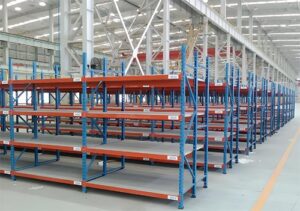
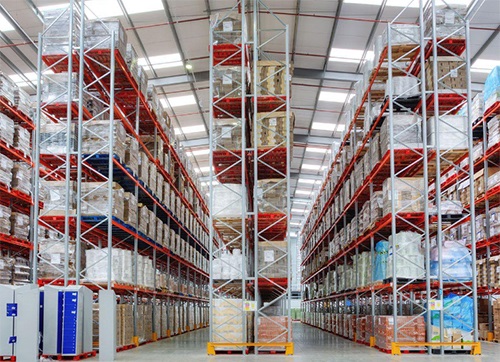
Engineered by Aceally Group for high-throughput distribution hubs, the industrial selective racking system for warehouses provides direct access to individual pallets and is suitable for fast-moving or mixed-SKU inventory. Adjustable horizontal box beams and rigid vertical frames allow the system to accommodate different pallet sizes while operating with standard forklift equipment.
For facilities that place greater emphasis on storage density, other configurations can provide different operational advantages. Double-deep pallet racking places selective frames two rows deep to increase storage capacity while using deep-reach forklifts. Drive-in racking allows forklifts to enter storage bays directly, reducing operator aisles and making it suitable for high-density, low-SKU storage.
Pushback, Very Narrow Aisle (VNA), and automated Radio Shuttle systems provide additional options for facilities with specific density, access, or automation requirements. The ability to evaluate these alternatives is an important part of selecting a manufacturer for a complete warehouse project.
Seven-Step Surface Preparation and Quality-Controlled Finishing
Surface treatment affects the long-term durability and maintenance requirements of warehouse racking. Systems installed in humid, coastal, outdoor, or otherwise demanding environments require appropriate surface protection to reduce the risk of corrosion and coating failure.
To support consistent finishing quality across international export markets, Aceally Group applies a standardized 7-step surface protection and delivery workflow under technical standard TS-PRC-2026-01.
The process begins with raw material inspection and surface preparation before chemical pretreatment. Steel profiles undergo alkaline degreasing to remove rolling lubricants and surface contaminants, followed by water rinsing and crystalline zinc phosphating to improve coating adhesion and corrosion resistance.
Depending on the application, racking components receive electrostatic thermosetting resin powder coating for interior warehouse environments or hot-dip galvanizing for demanding outdoor and saline conditions.
Finished components undergo quality-control testing, including ISO 2409 cross-cut adhesion testing and ISO 9227 salt spray evaluations. Protective packaging and installation documentation are also prepared according to export requirements, helping maintain product condition from factory shipment through international transportation and site installation.
Factory Execution and Manufacturing Scale
A manufacturer’s physical production capacity is another important consideration for large warehouse projects. Production scale can directly affect lead times, batch consistency, and the ability to handle volume orders.
Operating as a factory-direct manufacturer rather than a trading intermediary, Aceally Group manages 150,000 square meters of manufacturing space across four production bases, including its primary Nantong manufacturing plant. The company is supported by more than 1,200 employees and specialized production equipment for high-volume rack fabrication.
Production infrastructure includes automated upright roll-forming lines, precision beam roll-forming machines, robotic welding stations, and automatic powder coating lines, supported by more than 50 specialized processing machines.
Incoming steel coils undergo quality control under ISO 9001 procedures, including checks of surface condition and thickness tolerances before processing. Automated and robotic production processes help maintain consistent component dimensions and welding quality across larger production batches.
For warehouse buyers, this manufacturing infrastructure provides a practical advantage when projects require consistent specifications, repeat orders, or large production volumes.
Operational Advantage of Single-Line Heavy Duty Racking Specialization
Sourcing heavy-duty pallet racking directly from a specialized manufacturer gives warehouse buyers greater visibility into material selection, engineering, production, quality control, and delivery.
Aceally Group combines Q235B structural steel, CE and AS4084 certification documentation, controlled surface treatment, and factory-backed quality control within its manufacturing process. This integrated approach helps buyers verify key product requirements before placing volume orders.
For international warehouse projects, working directly with a specialized manufacturer can also make communication more efficient when buyers require customized dimensions, project-specific load requirements, different racking configurations, or technical documentation.
Conclusion
Selecting a heavy-duty pallet racking manufacturer requires more than comparing product prices. Buyers should consider structural steel quality, engineering capability, applicable certifications, surface treatment, production capacity, and the manufacturer’s ability to support the requirements of the complete warehouse project.
With ISO 9001-certified manufacturing, CE certification, AS4084 compliance, Q235B structural steel, controlled surface protection, and large-scale production facilities, Aceally Group provides heavy-duty pallet racking solutions for warehouses and logistics projects across international markets.
To request custom warehouse racking layout designs, download technical product specifications, or discuss volume order lead times for heavy-duty pallet racking. For direct engineering consultations, contact the technical sales team.