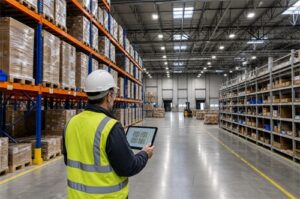
Walk into two warehouses storing the same type of pallets, and you may find completely different racking systems. One may use selective pallet racking, while another relies on drive-in or radio shuttle racking.
The reason is simple: no single pallet racking system works best for every warehouse.
The right choice depends on how much stock you need to store, how many SKUs you handle, how quickly products move, and how your forklifts operate.
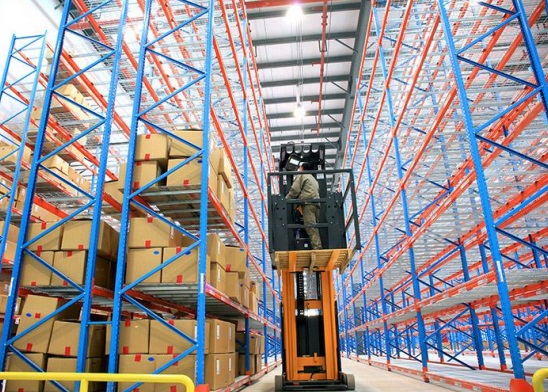
Selective Pallet Racking: The All-Round Choice
For many warehouses, selective pallet racking is the starting point.
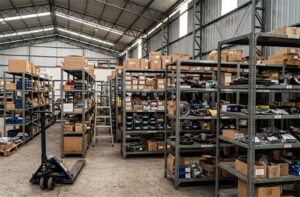
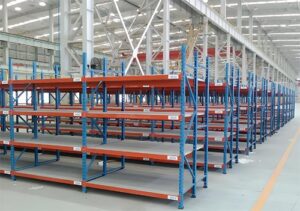
Its biggest advantage is direct access to every pallet. If your warehouse handles hundreds or thousands of different SKUs, this flexibility can save time during picking and replenishment.
It is commonly used in manufacturing plants, distribution centers, wholesale warehouses, and general storage facilities where inventory changes frequently.
Selective racking uses more aisle space than some high-density systems, but the trade-off is excellent accessibility. For warehouses where product availability and easy handling matter more than maximum storage density, it is often the most practical option.
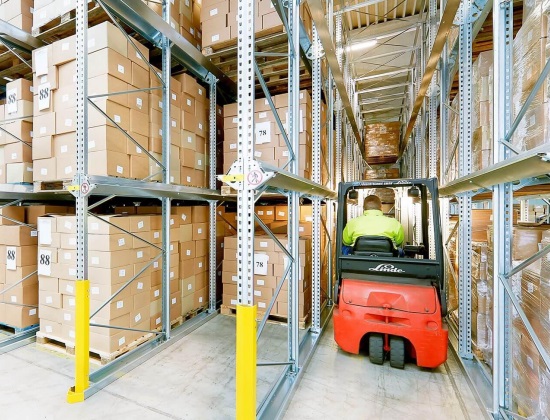
Drive-In Racking: When Storage Density Comes First
The situation changes when a warehouse stores large quantities of the same product.
Drive-in racking allows forklifts to enter the rack structure and place pallets several positions deep. By reducing the number of aisles, it can make better use of the available warehouse footprint.
This makes drive-in racking suitable for products stored in batches, such as beverages, food products, raw materials, and other goods with relatively low SKU variety.
The main trade-off is accessibility. Individual pallets cannot be accessed independently, so drive-in racking is generally best suited to LIFO (Last In, First Out) storage operations. When storage density is more important than direct pallet access, it can be an effective solution.
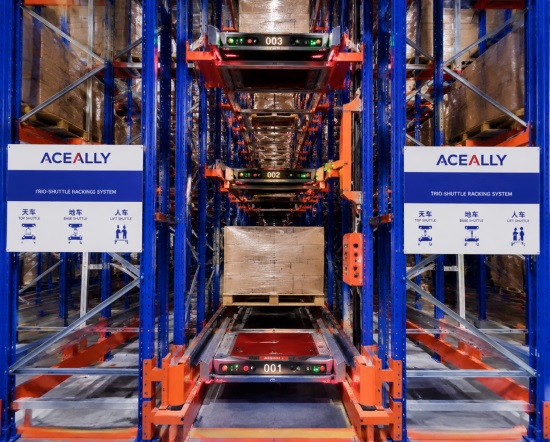
Radio Shuttle Racking: High Density With Less Forklift Travel
Radio shuttle racking is designed for warehouses that need high storage density without requiring forklifts to enter every storage lane.
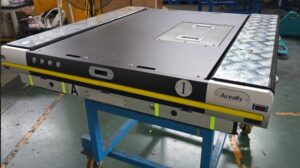
A battery-powered shuttle car moves pallets along the storage lane, while the forklift mainly operates at the front of the rack. This reduces forklift travel inside the rack and allows deeper storage lanes.
Radio shuttle systems are particularly suitable for food and beverage, cold storage, manufacturing, and distribution operations handling large quantities of the same or similar products.
Depending on the operating requirements, radio shuttle racking can support either FIFO or LIFO, giving warehouses more flexibility in inventory management than conventional drive-in systems.
Double-Deep Racking: A Balance Between Density and Access
Some warehouses need more storage density but cannot give up too much accessibility.
Double-deep pallet racking places two rows of pallets in depth, reducing the number of aisles while maintaining better access than deep-lane systems.
It is often a practical choice for warehouses that want higher density than selective racking but do not need the storage configuration of drive-in or shuttle systems.
Reach trucks or suitable material-handling equipment are normally required to access the rear pallet positions. The system works best when pallet quantities per SKU are sufficient to justify storing products two positions deep.
Pallet Flow Racking: For Fast-Moving and FIFO Products
For products that need to move through the warehouse in a controlled sequence, pallet flow racking offers a different approach.
Gravity rollers move pallets from the loading side toward the picking side, making FIFO (First In, First Out) easier to manage.
Because loading and picking can take place from opposite sides, pallet flow systems can also help separate replenishment from order picking.
This makes them particularly useful for food and beverage warehouses, cold storage facilities, and other operations where inventory age or expiration dates need to be closely controlled.
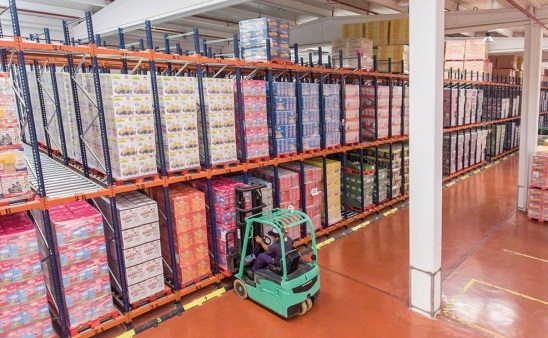
Pallet Racking System Comparison
| Racking System | Storage Density | Pallet Access | Best Suited For |
|---|---|---|---|
| Selective | Medium | Excellent | Many SKUs and frequent access |
| Drive-In | High | Limited | Bulk storage and LIFO |
| Radio Shuttle | Very High | Good | High-volume, dense storage |
| Double-Deep | High | Moderate | Fewer aisles with better access |
| Pallet Flow | High | Good | Fast-moving FIFO products |
How to Choose the Right System
Start with your warehouse operation rather than the rack itself.
Ask these questions:
- How many pallets do you need to store?
- How many different SKUs do you handle?
- How quickly does inventory move?
- Do you need FIFO or LIFO?
- What type of forklift will be used?
- How much warehouse height and floor space are available?
- Will storage requirements increase in the future?
As a quick guide, selective racking is usually the better choice for high SKU variety and direct access. Drive-in works well for bulk storage with fewer SKUs. Radio shuttle is worth considering when high density and reduced forklift travel are priorities. Double-deep offers a balance between density and accessibility, while pallet flow is particularly suitable for FIFO operations.
With nearly 30 years of experience in warehouse storage solutions, Aceally works with distributors, manufacturers, logistics companies, and warehouse operators to develop racking systems around actual operating requirements.
The best pallet racking system is not necessarily the one that stores the most pallets. It is the one that works best for the way your warehouse actually operates.