Choosing between slotted angle shelving and boltless rivet shelving involves more than comparing prices. Load capacity, shelf dimensions, installation efficiency, storage density, and future expansion requirements can all affect the final decision.
At Aceally Storage, we have extensive experience manufacturing industrial shelving and storage systems for international markets. Both systems are widely used, but each is better suited to different storage applications and warehouse requirements.
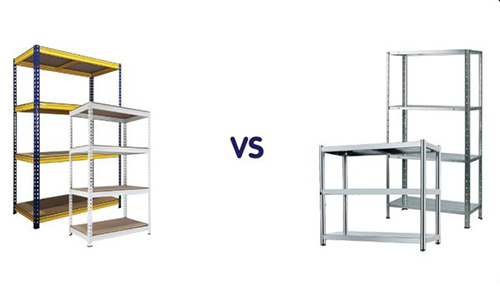
Slotted Angle vs. Boltless Rivet Shelving: Specification Comparison
| Specification | Slotted Angle Shelving | Boltless Rivet Shelving |
|---|---|---|
| Typical Unit Width | 600–1200 mm | 900–1800 mm |
| Typical Shelf Depth | 300–600 mm | 400–900 mm |
| Typical Unit Height | 1500–3000 mm | 1500–3000 mm |
| Steel Thickness | 1.5–2.5 mm | 1.2–2.0 mm |
| Typical Load Capacity | 100–300 kg/level | 200–500 kg/level |
| Assembly Method | Nuts and bolts | Boltless rivet connection |
| Installation Speed | Moderate | Fast |
| Shelf Adjustment | Flexible | Easy and tool-free |
| Common Decking | Steel board, MDF | Particle board, wire mesh, steel panels |
| Typical Application | Workshops, stockrooms, retail storage | Warehouses, spare parts, distribution |
The specifications above represent typical Aceally Storage configurations. Actual dimensions and load capacities should be determined according to shelf dimensions, beam profiles, upright design, decking material, load distribution, and project requirements.
Structure and Performance
Slotted angle shelving uses perforated angle steel connected with nuts and bolts. Its modular design offers excellent flexibility, particularly for customized dimensions and light- to medium-duty storage applications.
Boltless rivet shelving uses rivet beams and keyhole-style upright posts. Components can be assembled quickly, usually without conventional nuts and bolts, making the system suitable for projects where installation efficiency is important.
The two systems also differ in their typical storage configurations. Slotted angle shelving is often selected when customized dimensions and flexible configurations are important, while boltless rivet shelving is commonly used for larger shelf sizes and higher-capacity storage applications.
Load Capacity and Storage Requirements
Load capacity should be considered together with shelf dimensions, product weight, decking material, and load distribution. The typical load ranges shown above provide a general reference, but the actual capacity of a shelving unit depends on its specific configuration.
Slotted angle shelving can be a practical option for cartons, small parts, tools, stockroom inventory, and other light- to medium-duty applications. Boltless rivet shelving is often preferred for heavier products, larger storage areas, and warehouse or distribution applications where higher shelf capacity is required.
Before selecting a system, buyers should confirm the weight and dimensions of the products to be stored rather than choosing a shelving type based only on its appearance or initial price.
Installation and Shelf Adjustment
Installation is another important difference between the two shelving systems.
Slotted angle shelving requires nuts and bolts to connect the structural components. Although installation takes more time, the bolted construction provides flexibility when configuring customized shelving dimensions.
Boltless rivet shelving uses rivet connections between the beams and upright posts, allowing the main structure to be assembled more quickly. Shelf levels can also be adjusted without conventional bolting, which is useful when storage requirements change over time.
For projects involving a large number of shelving units, faster installation can reduce assembly time and labor requirements.
Customization and Space Utilization
Slotted angle shelving offers considerable flexibility when different shelf widths, depths, or heights are required. This makes it suitable for storage areas where available space or product dimensions do not follow standard configurations.
Boltless rivet shelving is also available in various sizes and configurations, with larger shelf widths and depths commonly used for warehouse and distribution applications.
The better choice depends on the available floor space and the products being stored. Customized slotted angle shelving may help make better use of irregular spaces, while larger boltless rivet units can provide efficient storage for bulkier products.
Which Shelving System Should You Choose?
The right shelving system depends on your products, load requirements, available space, and installation preferences.
Slotted angle shelving may be a better choice when you need:
- Customized shelf dimensions
- Flexible configurations
- Light- to medium-duty storage
- Workshop or stockroom applications
- Nuts-and-bolts construction
Boltless rivet shelving may be more suitable when you need:
- Faster installation
- Larger shelf dimensions
- Higher typical load capacity
- Easy shelf-level adjustment
- Warehouse, spare parts, or distribution storage
There is no single shelving system that is best for every application. The right choice should be based on the actual storage conditions and operating requirements.
How Can Aceally Storage Help You Choose?
The right shelving system should be selected based on the products you store, not simply on the initial purchase price.
Aceally Storage can help evaluate your storage project based on your required shelf loading, product dimensions, warehouse layout, available floor space, and operational requirements. We can then recommend whether a slotted-angle shelving system or a boltless-rivet shelving configuration will provide better storage efficiency and long-term value.
Our team can also support customized shelf dimensions, steel thickness, beam profiles, decking options, and loading configurations. For projects with specific requirements, we can help optimize the shelving layout before production.
Choosing the right shelving starts with understanding what you need to store, and Aceally Storage can help turn those requirements into a practical storage solution.