Where High-Density Storage Meets Efficient Pallet Handling
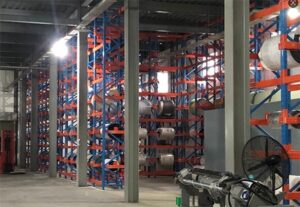
Warehouses often face a common challenge: how to increase storage density without slowing down pallet handling. Maximizing storage capacity typically means using deeper lanes and fewer aisles, while fast pallet movement requires efficient access and smooth forklift operations.
When forklifts have to repeatedly enter deep storage lanes, travel time can increase and congestion can become a problem during peak periods. Manual location tracking and pallet handling can also lead to errors, bottlenecks, and unnecessary product damage.
A Radio Shuttle Racking System helps balance these demands by allowing shuttle carts to handle pallet movement inside deep storage lanes while forklifts remain primarily at the rack entrance. The result is a high-density storage solution designed for warehouses with frequent pallet movements and large volumes of inventory.
What Is a Radio Shuttle Racking System and How Does It Work?
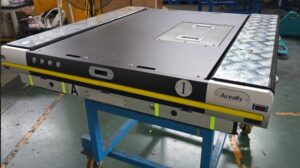
A Radio Shuttle is a powered shuttle cart that travels along rails installed inside the storage lanes of a pallet racking system. Instead of requiring a forklift to drive deep into each lane, the shuttle moves pallets between the storage positions and the front of the rack.
In a typical operation, a forklift places a pallet at the entrance of the storage lane. The shuttle then moves along the rails, positions the pallet in the designated storage location, and returns to the required position when the pallet needs to be retrieved.
Depending on the system configuration, the shuttle can be operated by remote control or integrated with warehouse management and control systems. This reduces forklift travel inside the storage lanes while allowing multiple pallets to be stored at greater depth.
Why Is Radio Shuttle Racking Suitable for High-Throughput Warehouses?
1. Reduce Forklift Travel Inside Storage Lanes
With conventional deep-lane storage, forklifts need to enter the storage lanes to place and retrieve pallets. This can take additional time, particularly when operators need to reach pallets located deep inside the rack.
With a Radio Shuttle system, forklifts can hand pallets over to the shuttle at the lane entrance instead of driving through the entire storage lane. The shuttle performs the internal pallet movement, helping reduce unnecessary forklift travel and making pallet handling more efficient during high-frequency operations.
The actual throughput improvement depends on the warehouse layout, pallet weight, lane depth, number of shuttle carts, forklift availability, and operating schedule.
2. Increase Storage Density by Reducing Forklift Aisle Requirements
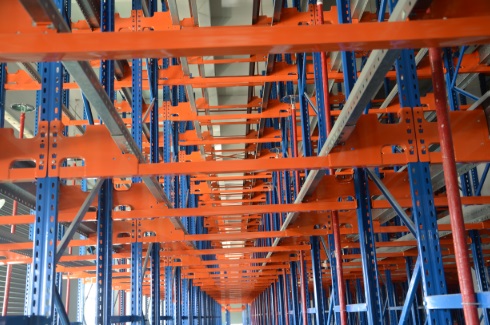
Traditional pallet racking requires working aisles between rack rows so forklifts can access individual pallet positions. Radio Shuttle racking uses storage lanes equipped with rails, allowing pallets to be stored several positions deep without requiring forklifts to enter every lane.
This can significantly increase the number of pallet positions available within the same warehouse footprint. The actual space savings depend on rack height, lane depth, pallet dimensions, aisle configuration, fire protection requirements, and the warehouse’s operating needs.
For warehouses handling large quantities of similar products or multiple pallets per SKU, the higher storage density can help reduce the need for additional floor space or external storage.
3. Support Frequent Pallet Handling and Heavy Loads
Radio Shuttle racking is designed for applications where pallets are moved frequently and storage lanes need to withstand continuous operation.
A properly engineered system combines reinforced rack structures, suitable rail components, and shuttle carts with load capacities matched to the pallet weight and operating requirements. When designed and installed correctly, the system can support repeated pallet storage and retrieval while maintaining stable operation.
For demanding applications such as cold-chain food storage, manufacturing materials, and other high-volume operations, the rack and shuttle should be selected according to pallet weight, operating frequency, environmental conditions, and local engineering requirements.
When Is Radio Shuttle Racking a Good Choice?
Radio Shuttle racking is particularly suitable for warehouses that handle large batches of palletized goods and require both high storage density and frequent inbound and outbound operations.
Typical applications include:
- Cold-chain and frozen food warehouses
- Pharmaceutical and chemical storage
- Manufacturing raw material and finished-goods warehouses
- High-volume e-commerce storage
- Home building material warehouses
- Large distribution and logistics facilities
It is especially useful when the warehouse stores multiple pallets of the same or similar products and does not require direct forklift access to every individual pallet position.
For facilities with strict inventory rotation requirements, the rack configuration can also be designed to support either LIFO (Last-In, First-Out) or FIFO (First-In, First-Out) operation, depending on the loading and retrieval arrangement.
Case Study 1: Large-Scale Cold Chain Food Warehouse in Saudi Arabia
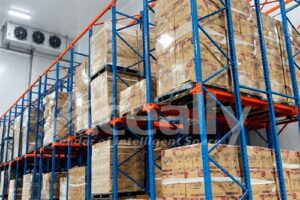
A large-scale cold-chain food warehouse in Saudi Arabia previously used traditional beam racking. During peak periods, the rapid inbound and outbound movement of frozen food caused frequent forklift congestion inside the aisles. Daily throughput was limited to approximately 800 pallets, while insufficient storage capacity also forced the company to rent additional external warehouse space.
After switching to an Aceally Radio Shuttle Racking System, storage capacity increased by 45%, eliminating the need for external storage. During peak periods, the warehouse achieved stable daily throughput of more than 2,000 pallets.
The project demonstrates how shuttle racking can help cold-chain warehouses combine higher storage density with more efficient pallet handling when large volumes of palletized products need to move through the facility.
Case Study 2: German Automotive Parts Manufacturing Warehouse
A German automotive parts manufacturer previously used traditional pallet racking to store heavy metal-stamped parts, with individual pallet loads exceeding 1.5 tons.
Frequent forklift entry into the storage aisles resulted in inefficient pallet handling and repeated safety incidents involving forklift-rack collisions. At the same time, disorganized batch management made it difficult to locate specific production material batches, slowing the supply of materials to the vehicle assembly line.
After installing the Aceally Radio Shuttle Racking System, shuttle carts were used to store and retrieve pallets according to their designated batches. The system was configured to support a FIFO workflow, helping improve batch organization and material traceability.
According to the project results, heavy-pallet handling efficiency increased by 1.8 times, rack collision incidents were eliminated, and warehouse storage capacity increased by 42%. The upgraded system met the requirements of the automotive factory’s continuous, high-volume, 24-hour production schedule.
Frequently Asked Questions
Q1: What high-throughput warehouse applications is Radio Shuttle racking suitable for?
Radio Shuttle racking is mainly designed for large-batch, high-turnover, full-pallet storage and retrieval. Typical applications include cold-chain food, pharmaceutical and chemical products, manufacturing raw materials and finished goods, e-commerce peak-season inventory, and building materials.
It is particularly suitable for medium and large warehouses that need high storage density together with frequent pallet movement.
Q2: Where does Radio Shuttle racking provide a throughput advantage over conventional dense storage?
Conventional dense storage systems may require forklifts to enter storage lanes to place and retrieve pallets. Radio Shuttle racking moves pallets within the lanes using powered shuttle carts, allowing forklifts to remain closer to the rack entrance.
This can reduce forklift travel, simplify pallet handling, and help increase overall throughput. The actual improvement depends on the warehouse layout, storage depth, pallet load, number of shuttle carts, and operating schedule.
Q3: Can Radio Shuttle racking be installed when renovating an existing warehouse?
Yes. Radio Shuttle systems can often be integrated into existing warehouses after evaluating conditions such as floor load capacity, clear height, building columns, fire protection, aisle layout, and access requirements.
Aceally provides warehouse design and racking planning services to develop a suitable configuration for both new construction and warehouse renovation projects. The extent of modification required depends on the existing building conditions and the proposed system design.
Q4: Does the system support future capacity expansion and intelligent upgrades?
Radio Shuttle systems can be designed with future expansion in mind. Depending on the original rack layout and control configuration, additional storage lanes, shuttle carts, or related equipment may be added as warehouse requirements grow.
The system can also be configured to connect with warehouse management or control software, supporting functions such as inventory tracking, batch management, data traceability, and further warehouse automation.
Improve High-Volume Warehouse Storage With Radio Shuttle Racking
For warehouses handling large volumes of palletized goods, storage density and handling efficiency need to work together. A Radio Shuttle Racking System reduces the need for forklifts to travel deep into storage lanes while making better use of available warehouse space.
Aceally manufactures Radio Shuttle racking systems for different warehouse requirements, with rack configurations, lane depths, load capacities, and shuttle specifications customized according to the application.
For a new warehouse or an existing facility that needs higher storage capacity and more efficient pallet handling, contact Aceally to discuss a Radio Shuttle solution designed around your warehouse layout and operational requirements.