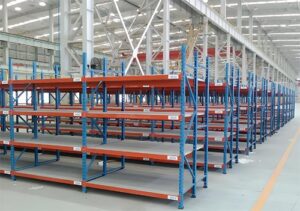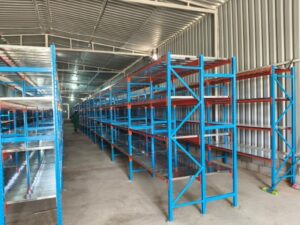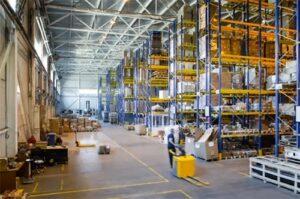
Longspan shelving is used for storing cartons, boxes, parts, tools, bins, and other goods that need to be stored across multiple levels and accessed manually. It is commonly used in warehouses, workshops, manufacturing facilities, parts stores, and other storage areas where products are too large or heavy for light-duty shelving but do not need to be stored on pallets.
Longspan shelving typically supports around 200–1000 kg per shelf level, depending on the shelf size, span, materials, and structural design. This range allows it to handle everything from general cartons and packaged goods to heavier components, tools, and industrial parts.
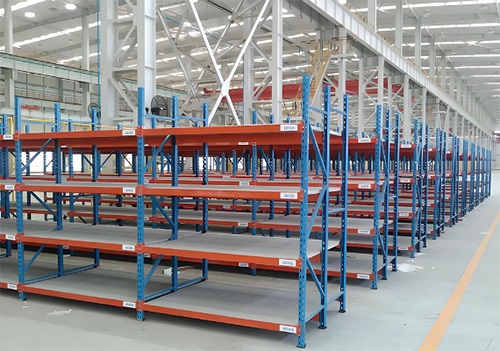
What Can You Store on Longspan Shelving?
The main advantage of longspan shelving is its ability to accommodate different types of inventory without requiring pallet storage. The appropriate configuration depends on the size and weight of the items being stored.
Cartons and Boxes
Cartons and boxes are common applications for longspan shelving. Individual boxes can be arranged by product type, SKU, size, or picking frequency, making stock easier to locate and retrieve.
It is particularly useful when products are handled one box or package at a time rather than moved as complete pallets.
Parts and Components
Longspan shelving is widely suited to parts storage, including mechanical components, spare parts, hardware, and other industrial items.
Smaller parts can be placed in plastic bins or containers, while larger components can be stored directly on the shelves. Different shelf levels can also be arranged according to the size of the inventory.
Tools and Workshop Supplies
Workshops and manufacturing areas can use longspan shelving for tools, maintenance supplies, replacement parts, and production materials.
The open storage arrangement provides direct access to frequently used items while keeping them separated and organized.
Bins and Containers
Plastic bins, totes, and other containers can be placed on longspan shelving to create individual storage locations for smaller products and components.
This is useful for warehouses and workshops with many SKUs that need to be identified and picked individually.
Heavier Industrial Items
With higher-capacity configurations, longspan shelving can also store heavier components, equipment parts, and other dense inventory.
For example, a system rated at several hundred kilograms per level can provide substantially more capacity than light-duty shelving while still allowing workers to access individual items manually.
How Much Weight Can Longspan Shelving Hold?
Longspan shelving can cover a relatively wide range of storage requirements. A typical system may be designed for approximately 200–1000 kg per shelf level, with the actual capacity depending on the configuration.
Lower-capacity configurations can be suitable for cartons, boxes, bins, and general inventory, while higher-capacity systems can be used for heavier parts, tools, and industrial components.
Load capacity is normally specified based on a uniformly distributed load (UDL). This means the rated capacity assumes that the weight is distributed across the shelf rather than concentrated in one small area.
The shelf dimensions and span are also important. A longer shelf span may require a different beam or shelf construction to achieve the required load capacity.
For this reason, the required load per level should be considered together with the shelf width, depth, number of levels, and the type of goods being stored.
Where Is Longspan Shelving Used?
Longspan shelving is suitable for many environments where inventory is handled manually.
Warehouses
In warehouses, it can be used for carton storage, spare parts, picking stock, and products that are not stored on pallets.
It can also work alongside pallet racking. Pallet racking can hold bulk palletized inventory, while longspan shelving can be used for individual cartons, smaller items, and order-picking stock.
Manufacturing Facilities
Manufacturers can use longspan shelving to organize components, production materials, tools, and maintenance parts near work areas.
Keeping these materials on dedicated shelving can make individual items easier to identify and retrieve.
Workshops
In workshops, longspan shelving can provide storage for tools, spare parts, consumables, and equipment.
Different levels can be assigned to different categories, helping keep frequently used items off the floor and within easy reach.
Automotive Parts Storage
Automotive parts often vary considerably in size, weight, and quantity. Longspan shelving can provide separate storage locations for boxed parts, components, accessories, and other inventory that is manually picked.
Retail Stockrooms
Retailers can use longspan shelving in stockrooms to organize back-up inventory and products waiting to be replenished on the sales floor.
The shelving can provide multiple accessible storage levels without requiring pallet handling equipment.
Why Is Longspan Shelving Suitable for These Applications?
Longspan shelving fills the gap between light-duty shelving and pallet racking for many storage operations.
It is particularly useful when:
- Goods need to be accessed individually by workers.
- Inventory includes cartons, boxes, bins, parts, or tools.
- Different products require different shelf heights.
- Several storage levels are needed to use vertical space.
- The required load capacity is higher than typical light-duty shelving.
- Pallets and forklifts are not necessary for everyday picking.
Its relatively flexible configuration also makes it suitable for storage areas where inventory changes over time.
Longspan Shelving or Pallet Racking?
The choice largely depends on how the goods are stored and handled.
Longspan shelving is generally intended for manual storage and picking of individual items, cartons, boxes, parts, and containers.
Pallet racking is generally intended for palletized goods that are loaded and retrieved using forklifts or other material-handling equipment.
For example, a warehouse may use pallet racking for reserve stock stored on pallets and longspan shelving for smaller quantities that need to be picked manually.
The two systems can therefore be used in the same warehouse rather than being mutually exclusive.
Choosing Longspan Shelving for Your Storage Needs
The right longspan shelving configuration depends on more than the total amount of storage space available. Consider the weight and dimensions of the goods, required load capacity per level, shelf width and depth, number of levels, and how frequently the items will be accessed.
For general cartons and bins, a lower-capacity configuration may be sufficient. Heavier industrial parts or dense inventory may require a higher-capacity system with an appropriate shelf and beam design.
When these factors are matched to the shelving configuration, longspan shelving can provide a practical solution for organized, accessible storage across a wide range of warehouse and industrial applications.