What Is Drive-In Racking?
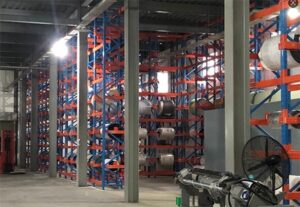
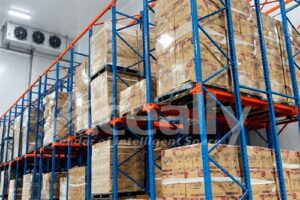
Drive-in pallet racking is a high-density storage system designed to maximize warehouse space by reducing aisle requirements. Unlike selective pallet racking, forklifts drive directly into storage lanes, placing pallets onto side support rails rather than horizontal beams.
This system is widely used in cold storage, food and beverage, manufacturing, and other industries where large volumes of the same SKU are stored. By minimizing aisles and increasing depth, it significantly improves cubic space utilization.
How Drive-In Racking Works
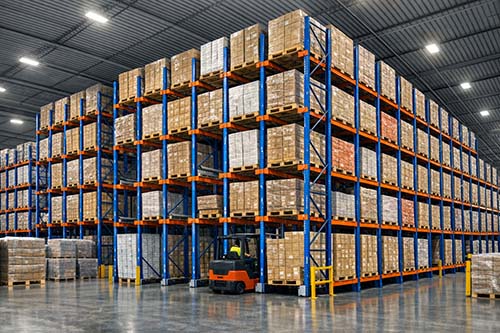
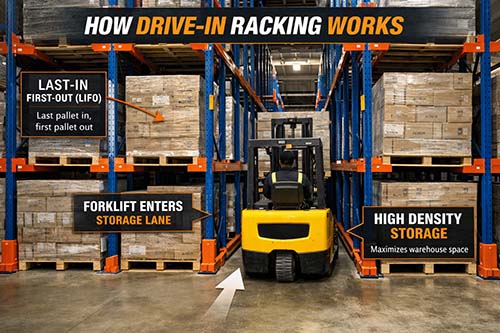
In a drive-in racking system, pallets are stored one behind another within deep lanes. A forklift enters the lane and places each pallet on support rails. This structure creates a high-density storage configuration with fewer aisles compared to conventional systems.
Because of this arrangement, the system typically operates on a LIFO (Last-In, First-Out) basis. The last pallet placed into the lane is the first one retrieved. This makes drive-in racking ideal for bulk storage of uniform products where stock rotation is less critical.
Compared with other high-density systems such as push back racking or shuttle racking, drive-in racking offers a simpler and more cost-effective solution, but requires more careful forklift operation and pallet consistency.
Drive-In Racking Structure and Key Components
A drive-in racking system must withstand repeated forklift entry, concentrated loads, and deep-lane storage pressure. Each structural component plays a critical role in maintaining safety and long-term performance.
| Component | Function | Why It Matters |
|---|---|---|
| Upright Frames | Main vertical structure | Supports overall load and stability |
| Pallet Rails | Hold pallet edges | Critical for safe pallet placement |
| Top Beams | Connect uprights | Improve rigidity and alignment |
| Bracing | Reinforcement | Prevents sway and torsion |
| Entry Guides | Forklift alignment | Reduces collision damage |
| Pallet Stops | Limit pallet depth | Prevents overtravel |
Upright frames form the backbone of the system and must be selected based on real working conditions, including load weight and forklift impact risk. Pallet rails must match pallet dimensions to ensure stable loading.
Forklift Requirements for Drive-In Racking
Unlike selective pallet racking, forklifts in a drive-in system must enter the storage lanes. This requires higher precision, better visibility, and tighter maneuvering control.
| Requirement | Why It Is Important |
|---|---|
| Vehicle Width | Must fit safely within lane width |
| Lift Height | Reach top pallet levels |
| Fork Length | Match pallet size |
| Visibility | Accurate pallet placement |
| Stability | Safe entry and exit |
Common Forklift Types
Counterbalance forklifts are the most commonly used due to their versatility and lifting capacity. Reach trucks may be used in certain layouts, while guided forklifts are suitable for highly engineered systems.
Drive-In Racking Safety Guidelines
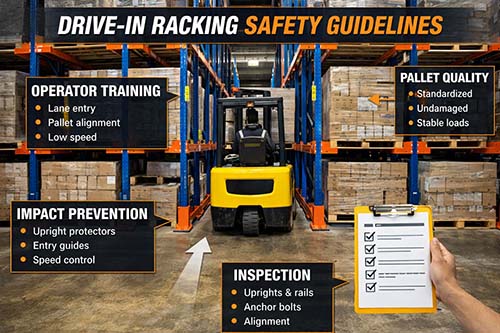
Because forklifts operate inside the rack structure, safety must be integrated into both design and daily operation.
Operator Training
Operators must be trained to enter lanes correctly, align pallets with rails, and maintain low speeds to avoid impact.
Pallet Quality
Only standardized, undamaged pallets should be used. Poor pallet condition increases the risk of instability and accidents.
Impact Prevention
Use upright protectors, entry guides, and floor barriers to reduce collision risk.
Inspection and Maintenance
Regular inspections should include checking for bent uprights, rail deformation, loose anchors, and alignment issues.
Drive-In vs Other High-Density Racking Systems
Different high-density systems support different warehouse operations. Choosing the right one depends on SKU variety and throughput requirements.
| System | Storage Flow | Density | Best Use |
|---|---|---|---|
| Drive-In | LIFO | High | Bulk same SKU |
| Push Back | LIFO | Medium | Multiple SKUs |
| Shuttle | FIFO/LIFO | Very High | Automation |
Is Drive-In Racking Right for Your Warehouse?
- You store large volumes of the same SKU
- You want to maximize storage density
- LIFO inventory flow is acceptable
- Pallets are consistent in size and condition
- Operators are trained for lane entry
Get a Free Drive-In Racking Design
We provide customized drive-in racking solutions based on your warehouse layout, pallet size, and operational requirements.
Send us your warehouse details today to get started.