In modern warehouse operations, selecting the right pallet racking system directly affects storage capacity, inventory management, forklift efficiency, and long-term operating costs. As warehouse space becomes more expensive and customer demand continues to increase, companies need storage solutions that maximize available space while maintaining smooth daily operations.
Among the most widely used warehouse storage systems, selective pallet racking and drive-in pallet racking are two proven solutions for pallet storage. Both systems provide reliable performance for industrial warehouses, but they are designed for different storage requirements.
Selective pallet racking focuses on maximum accessibility and flexible inventory management, while drive-in racking prioritizes high-density storage and better space utilization. Understanding the differences between these two systems helps warehouse owners, distributors, and logistics companies choose the most suitable solution based on their products, operational processes, and future expansion plans.
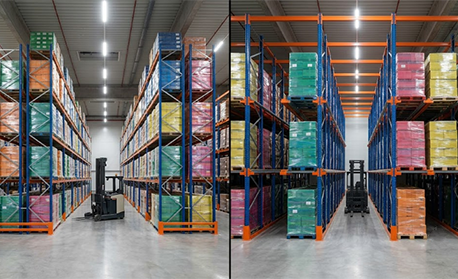
What Is Selective Pallet Racking?
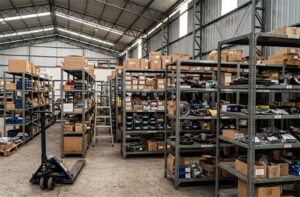
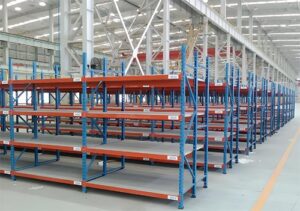
Selective pallet racking is the most common pallet storage system used in warehouses worldwide. Its main feature is that every pallet position can be accessed directly from the warehouse aisle, allowing forklifts to retrieve or store individual pallets without moving other inventory.
This open-access design makes selective racking an ideal choice for warehouses that handle a wide range of products, multiple SKUs, or frequent pallet picking operations. It provides excellent inventory visibility and supports efficient stock rotation, especially for industries requiring strict batch control or frequent product changes.
The main advantages of selective pallet racking include:
- 100% pallet accessibility: Every pallet location can be reached directly by forklift.
- Flexible inventory management: Suitable for warehouses with high SKU variety.
- Easy installation and adjustment: Beam levels can be modified according to changing storage requirements.
- Lower initial investment: Compared with higher-density systems, selective racking generally requires less specialized equipment.
However, because each pallet requires direct forklift access, selective pallet racking needs wider aisles compared with compact storage systems. This means part of the warehouse floor area must be reserved for forklift movement, which limits overall storage density.
What Is Drive-In Pallet Racking?
Drive-in pallet racking is a high-density storage system designed to maximize warehouse capacity by reducing the number of operating aisles. Instead of accessing every pallet from the front, forklifts enter the rack lanes directly to place or retrieve pallets stored in depth.
By eliminating most aisle requirements, drive-in racking can significantly increase storage density compared with traditional selective pallet racks. It is especially suitable for warehouses where available space is limited, including cold storage facilities, food and beverage warehouses, and bulk storage operations.
Key advantages of drive-in pallet racking include:
- Higher storage density: More pallet positions can be installed within the same warehouse footprint.
- Better space utilization: Reduced aisle requirements allow more space to be used for product storage.
- Ideal for homogeneous products: Best suited for large quantities of the same or similar SKUs.
- Excellent for temperature-controlled warehouses: Maximizes expensive cold storage space.
The main limitation of drive-in racking is accessibility. Since pallets are stored deeper inside rack lanes, operators may need to move front pallets before reaching products stored behind them. Therefore, drive-in systems are generally better suited for warehouses with lower SKU diversity and products that do not require frequent individual pallet picking.
Selective vs Drive-In Racking: Key Differences
Although both selective pallet racking and drive-in pallet racking are designed for pallet storage, their operating principles are quite different. The best choice depends on how a warehouse manages inventory, how often products are accessed, and how much storage density is required.
1. Storage Density and Space Utilization
The biggest difference between selective and drive-in racking is storage density. Selective pallet racking requires dedicated aisles so forklifts can access each pallet position directly. This design provides excellent accessibility but uses more floor space for transportation areas.
Drive-in pallet racking reduces the number of aisles by allowing forklifts to enter storage lanes. As a result, more warehouse space can be dedicated to pallet storage instead of forklift movement. Depending on warehouse layout, pallet dimensions, and storage configuration, drive-in systems can provide significantly higher storage density than selective racking.
This density advantage is particularly valuable in warehouses where space costs are high. For example, cold storage facilities often choose drive-in racking because expanding the building area or refrigeration capacity can be extremely expensive. Maximizing existing storage volume helps companies reduce long-term facility costs.
However, higher density does not always mean better performance. Warehouses must balance storage capacity with operational requirements. A system that stores more pallets but slows down product retrieval may not be the most efficient solution for high-turnover inventory.
2. Pallet Accessibility and Inventory Management
Accessibility is where selective pallet racking has its greatest advantage. Since every pallet position is directly available from the aisle, operators can quickly locate and retrieve any stored pallet without moving other inventory.
This makes selective racking suitable for businesses that manage:
- High SKU variety
- Frequent pallet picking
- Short product cycles
- Strict inventory traceability requirements
Selective pallet racking supports both FIFO (First-In, First-Out) and LIFO (Last-In, First-Out) inventory methods, making it widely used in industries such as retail distribution, manufacturing, and general logistics.
Drive-in racking follows a different operating model. Because pallets are stored several positions deep within each lane, access is generally based on a LIFO (Last-In, First-Out) principle. The forklift typically loads and retrieves pallets from the same side, meaning deeper pallets are accessed after front pallets are removed.
For warehouses storing large quantities of the same product, this limitation is usually acceptable. Industries such as beverage, frozen food, raw materials, and seasonal goods often benefit from the high-density storage capability of drive-in systems because product rotation requirements are relatively simple.
Selective vs Drive-In Pallet Racking Comparison
| Feature | Selective Pallet Racking | Drive-In Pallet Racking |
|---|---|---|
| Storage Density | Medium density with more aisle space | High density by reducing aisles |
| Pallet Accessibility | Direct access to every pallet | Limited access to pallets stored deeper in lanes |
| Inventory Type | Suitable for multiple SKUs | Best for bulk storage with fewer SKUs |
| FIFO Support | Excellent support | Limited unless using drive-through design |
| Forklift Operation | Forklift operates in aisles | Forklift enters rack storage lanes |
| Best Applications | General warehouses, distribution centers, retail logistics | Cold storage, bulk goods, seasonal inventory |
Cost Considerations: Initial Investment vs Total Cost of Ownership
When comparing selective pallet racking and drive-in pallet racking, the initial equipment cost is only one part of the decision. A more complete evaluation should consider total cost of ownership, including warehouse space requirements, forklift operations, labor efficiency, and future expansion needs.
Selective pallet racking generally requires a lower initial investment because of its simpler structure and easier installation process. Since each pallet location is independently accessible, it does not require specialized operating methods or additional equipment investment. For warehouses with sufficient floor space and a wide product range, selective racking often provides an excellent balance between cost and operational flexibility.
Drive-in pallet racking usually requires a higher investment due to its stronger structural design and deeper storage configuration. However, the additional cost can be justified when warehouse space is limited or expensive. By reducing aisle requirements and increasing pallet density, drive-in systems can help companies store more products within the same building area.
For example, in urban warehouses where expansion costs are high, improving storage density may create greater long-term value than choosing the lowest initial equipment price. Similarly, in cold storage facilities, maximizing available cubic space can significantly reduce the cost per stored pallet.
Therefore, the right comparison should not only focus on rack price, but also evaluate:
- Available warehouse space
- Product storage characteristics
- Inventory turnover rate
- Forklift operating efficiency
- Future business growth plans
Application Scenarios: Which System Fits Your Warehouse?
The best pallet racking system depends on the way a warehouse operates. Neither selective pallet racking nor drive-in pallet racking is universally better; each system is designed for different storage challenges.
Selective Pallet Racking Is Ideal For:
- Distribution centers with high SKU diversity: Warehouses handling many different products benefit from direct pallet access and better inventory visibility.
- Retail supply chains: Frequent picking operations require fast access to individual pallets and flexible stock management.
- Manufacturing facilities: Production environments often need reliable access to different raw materials and components.
- Warehouses requiring FIFO management: Products with expiration dates or strict batch tracking benefit from full accessibility.
Drive-In Pallet Racking Is Ideal For:
- Cold storage warehouses: High-density storage helps maximize expensive temperature-controlled space.
- Food and beverage storage: Large quantities of similar products can be stored efficiently.
- Seasonal inventory: Products with predictable demand patterns can be stored in bulk.
- Warehouses with limited expansion space: Higher storage density helps increase capacity without enlarging the facility.
How to Choose Between Selective and Drive-In Pallet Racking?
Before selecting a pallet racking system, warehouse owners should evaluate several key factors:
- Inventory Profile:
If your warehouse stores many different SKUs and requires frequent pallet access, selective racking is usually the better choice. If you store large quantities of the same products, drive-in racking may provide better efficiency. - Warehouse Space:
Facilities with limited floor area or high real estate costs should consider high-density storage solutions such as drive-in pallet racking. - Material Handling Process:
Forklift type, operator experience, and daily pallet movement frequency all influence system selection. - Future Expansion:
A good racking design should not only solve current storage problems but also support future business growth.
Conclusion
Choosing between selective pallet racking and drive-in pallet racking is not simply a decision between a traditional system and a high-density system. The right solution depends on your warehouse layout, inventory characteristics, operational requirements, and long-term business objectives.
Selective pallet racking remains one of the most versatile warehouse storage solutions, offering excellent accessibility, flexibility, and inventory control. Drive-in pallet racking provides outstanding storage density for businesses that need to maximize warehouse capacity and store large quantities of similar products.
At Aceally Group, we help global customers design pallet racking systems based on real warehouse requirements, including product type, storage volume, forklift operations, and future expansion plans. With professional engineering support and customized manufacturing capabilities, Aceally provides reliable storage solutions for warehouses across different industries.
Whether you need selective pallet racking, drive-in pallet racking, or a customized high-density storage solution, our engineering team can help you choose the most efficient system for your operation.