Introduction: Understanding Warehouse Racking Systems
Warehouse storage requirements continue to evolve as businesses manage larger inventories, faster order fulfillment, and increasing space limitations. A well-designed racking system helps companies maximize warehouse capacity, improve inventory organization, and create safer material handling operations.
There are different types of racking systems in warehouse environments, and each solution is designed for specific storage requirements. Factors such as product type, pallet size, storage density, inventory turnover, and forklift operation all influence the selection of the right racking system.
From widely used selective pallet racking to high-density solutions such as drive-in and radio shuttle systems, different warehouse racks provide different advantages. Understanding their applications helps businesses choose a storage solution that improves efficiency while supporting long-term operational needs.
Key Factors When Choosing Warehouse Racking:
- Warehouse layout and available space
- Product dimensions and pallet specifications
- Required storage density
- Inventory rotation method (FIFO or LIFO)
- Forklift and material handling equipment
Overview of Different Types of Warehouse Racking Systems
Warehouse racking systems can be divided into several categories based on storage methods, loading requirements, and operational needs.
| Racking Type | Main Application |
|---|---|
| Selective Pallet Racking | General pallet storage with direct access to every pallet |
| Drive-In Pallet Racking | High-density storage for large quantities of similar products |
| Double Deep Pallet Racking | Higher storage density while maintaining better accessibility |
| Radio Shuttle Racking | Semi-automated high-density pallet storage |
| Push Back Pallet Racking | Multi-depth storage for warehouses requiring higher capacity |
| Cantilever Racking | Long and oversized material storage |
| Long Span Shelving | Manual picking and medium-duty storage |
Main Types of Warehouse Racking Systems and Their Uses
Among the different warehouse storage solutions available, pallet racking systems remain the most common choice for industrial warehouses because of their flexibility, scalability, and compatibility with different handling equipment.
1. Selective Pallet Racking
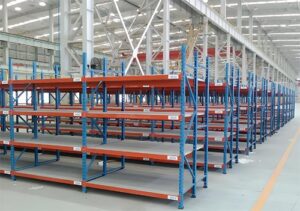
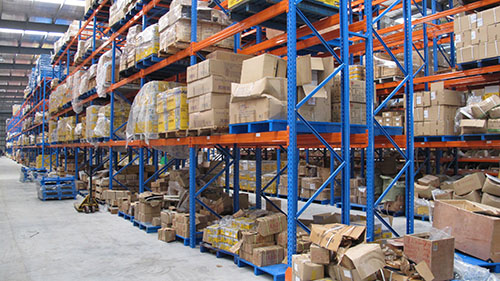
Selective pallet racking is the most widely used warehouse racking system. It provides direct access to every pallet position, making it suitable for warehouses that handle multiple products and require efficient inventory management.
Its flexible design allows beam levels, rack heights, and configurations to be adjusted according to pallet dimensions, load requirements, and warehouse layouts.
Best For:
Distribution centers, manufacturing facilities, retail warehouses, and 3PL storage operations.
2. Drive-In Pallet Racking
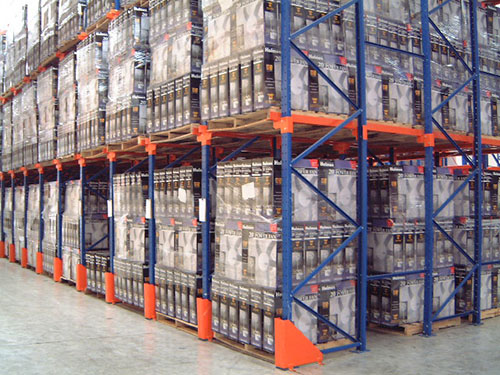
Drive-in pallet racking is a high-density storage solution designed to maximize warehouse capacity by reducing the number of aisles required.
Forklifts can enter the rack lanes directly to load and retrieve pallets, allowing more products to be stored within the same warehouse area compared with conventional selective racks.
Best For:
Cold storage, food and beverage warehouses, and bulk inventory storage.
3. Double Deep Pallet Racking
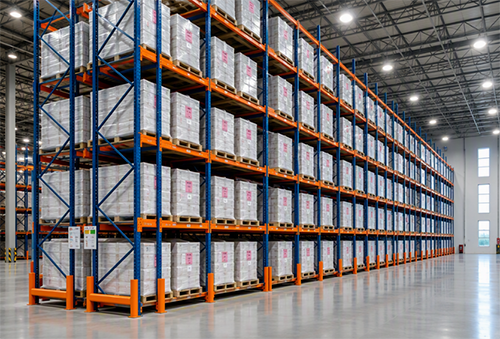
Double deep pallet racking is a modified version of selective pallet racking that increases storage capacity by placing two rows of pallets back-to-back. Compared with standard selective racks, it reduces the number of aisles required and improves warehouse space utilization.
This system provides a balance between accessibility and storage density. While forklifts cannot access every pallet directly from the aisle, it offers higher capacity than selective racking without the operational complexity of fully dense storage systems.
Double deep racking usually requires reach trucks or specialized handling equipment because pallets are stored at greater depth.
Warehouses that need higher storage density than selective pallet racking while maintaining relatively good pallet accessibility.
Common Applications:
- Distribution centers
- Manufacturing warehouses
- Cold storage facilities
- Warehouses with medium SKU quantities
4. Radio Shuttle Racking System
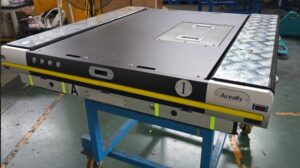
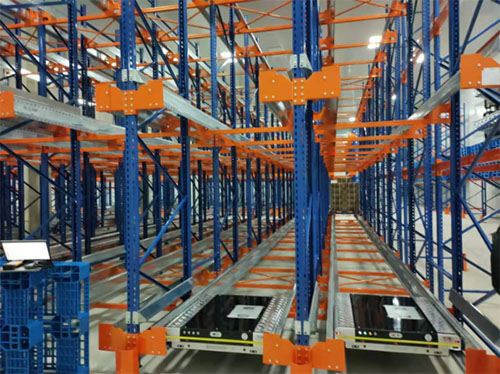
Radio shuttle racking is an advanced high-density pallet storage system that uses a motorized shuttle cart to move pallets inside deep rack lanes. Unlike traditional drive-in racking, forklifts do not need to enter the storage channels, which helps improve safety and reduce rack damage.
The shuttle cart automatically transfers pallets between storage positions and the loading area, making this system suitable for warehouses that handle large pallet volumes and require efficient storage operations.
Compared with conventional high-density racking, radio shuttle systems provide better control over pallet movement and can be integrated into warehouses with semi-automated processes.
High-volume warehouses that require maximum storage capacity with improved operational efficiency.
Common Applications:
- Cold chain warehouses
- Food and beverage storage
- Large distribution centers
- Raw material storage facilities
5. Push Back Pallet Racking
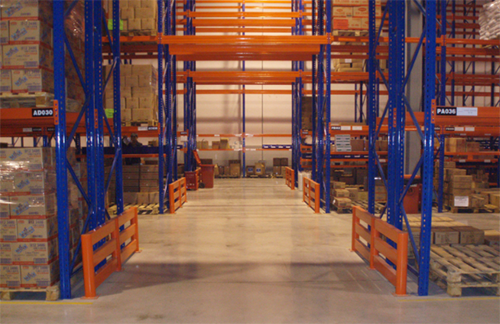
Push back pallet racking is designed for warehouses that require increased storage density while maintaining faster access compared with drive-in systems.
The system uses inclined rails and nested carts. When a new pallet is loaded, it pushes previously stored pallets backward along the rack lane. When pallets are removed, the remaining pallets automatically move forward by gravity.
Push back racking is commonly configured with multiple pallet positions deep, making it suitable for storing several pallets of the same product while reducing the amount of warehouse floor space required.
Warehouses that need higher storage density with faster loading and unloading from the aisle side.
Common Applications:
- Manufacturing warehouses
- Food and beverage storage
- Distribution centers
- Seasonal inventory storage
Comparison of Main Pallet Racking Systems
Different pallet racking systems are designed for different warehouse priorities. The following comparison helps identify the main differences between common solutions.
| System | Main Advantage | Suitable For |
|---|---|---|
| Selective Pallet Racking | Direct access to every pallet | General warehouse storage |
| Double Deep Racking | Higher density with reasonable accessibility | Medium-volume pallet storage |
| Drive-In Racking | Maximum storage density | Bulk storage |
| Radio Shuttle Racking | High density with reduced forklift movement | Large-scale warehouses |
| Push Back Racking | Multi-depth storage with faster access | Multiple pallet storage |
Other Types of Warehouse Storage Systems
Besides pallet racking systems, warehouses may require specialized storage solutions for long materials, manual picking operations, or products with unique dimensions. These systems are designed to solve specific storage challenges that standard pallet racks cannot handle efficiently.
6. Cantilever Racking System
Cantilever racking is designed for storing long, oversized, and irregular-shaped materials that are difficult to store on conventional pallet racks.
Unlike traditional racking systems that use front and rear frames, cantilever racks use vertical columns and horizontal arms to create an open storage structure. This design allows forklifts and operators to easily load and remove products from the front side.
Because of its flexible structure, cantilever racking is widely used in industries that handle long products, construction materials, and heavy industrial components.
Best For:
Long and oversized products that require open-front storage access.
Common Applications:
- Steel pipes and metal profiles
- Lumber and timber storage
- Aluminum extrusion materials
- Furniture components
- Building materials
7. Long Span Shelving System
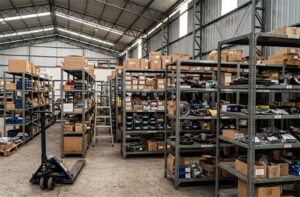
Long span shelving is a medium-duty storage solution designed for warehouses that rely on manual picking rather than pallet handling.
With stronger beams and wider shelf spans than traditional shelving, it provides an efficient way to organize cartons, spare parts, tools, and small components while maintaining easy access for operators.
Long span shelving is commonly used in warehouses where products are stored individually instead of on pallets.
Best For:
Manual picking areas, spare parts storage, and small product inventory management.
Common Applications:
- E-commerce fulfillment centers
- Automotive parts warehouses
- Maintenance workshops
- Small manufacturing facilities
8. Mezzanine Floor System
A warehouse mezzanine floor creates an additional working or storage level by utilizing unused vertical space inside an existing building.
Instead of expanding warehouse space horizontally, mezzanine systems help businesses increase usable area without moving to a larger facility.
They can be combined with shelving, pallet racks, offices, or work platforms depending on operational requirements.
Common Applications:
Warehouses, manufacturing plants, e-commerce facilities, and distribution centers.
9. Boltless Rivet Shelving and Slotted Angle Shelving
Boltless rivet shelving and slotted angle shelving are flexible storage solutions commonly used for light-duty and medium-duty applications.
They are suitable for businesses that need economical storage systems with simple installation and adjustable shelf levels.
Typical applications include:
- Workshops
- Archives
- Garages
- Small parts storage
- Retail back rooms
10. Specialty Storage Racks
Some industries require customized storage solutions based on specific product shapes, handling methods, or operational requirements.
Examples include:
- Sheet Metal Storage Rack: Designed for organizing steel sheets, aluminum plates, and flat materials.
- Tire Storage Rack: Used for automotive tire storage and distribution operations.
- Stacking Rack: Provides flexible and reusable storage for manufacturing and logistics applications.
- Custom Storage Rack: Designed according to specific product dimensions and warehouse requirements.
How to Choose the Right Warehouse Racking System
Choosing the right warehouse racking system requires more than comparing storage capacity. A suitable solution should match your warehouse layout, product characteristics, inventory management method, and daily operating process.
Before selecting a racking system, warehouse operators should evaluate the following factors:
1. Warehouse Space and Layout
The available warehouse space directly affects rack design and storage efficiency. Important factors include:
- Warehouse height and floor area
- Column positions and building structure
- Aisle width requirements
- Forklift operating space
For warehouses with limited floor space but sufficient building height, high-density systems such as drive-in or radio shuttle racking can help maximize storage capacity.
For warehouses that require frequent access to individual pallets, selective pallet racking is usually a more flexible solution.
2. Product Type and Storage Requirements
Different products require different storage solutions. Before choosing a rack system, consider:
- Product dimensions and weight
- Pallet size and loading method
- Number of SKUs
- Storage frequency and picking requirements
For example, palletized goods are usually stored with pallet racking systems, while long materials such as pipes or steel profiles are better suited for cantilever racks.
3. Inventory Rotation Method
Inventory management requirements also influence racking selection.
| Inventory Requirement | Recommended System |
|---|---|
| Direct access to every pallet | Selective Pallet Racking |
| Large quantity of same products | Drive-In / Radio Shuttle Racking |
| Higher density with multiple pallets per SKU | Double Deep / Push Back Racking |
4. Material Handling Equipment
Forklift type and warehouse equipment should be considered during rack design.
Common equipment includes:
- Counterbalance forklifts
- Reach trucks
- Narrow aisle forklifts
- Automated guided vehicles (AGVs)
The rack layout, aisle width, and storage height should always be designed according to the actual handling equipment used in the warehouse.
Warehouse Racking Safety Considerations
A properly designed warehouse racking system improves storage efficiency, but safety should always be a priority. Regular maintenance and correct operation are essential for long-term rack performance.
Important Warehouse Racking Safety Practices:
- Follow Load Capacity Requirements:
Rack beams, uprights, and components should always operate within their designed load limits. - Use Safety Accessories:
Accessories such as upright protectors, safety pins, wire mesh decking, and rack guards help reduce damage risks. - Perform Regular Inspections:
Routine checks help identify damaged components, overloaded sections, or potential safety issues.
Why Choose Aceally for Warehouse Racking Systems?
Selecting the right storage system requires not only suitable products but also professional engineering support. As a warehouse racking manufacturer, Aceally provides customized storage solutions designed around different warehouse environments and operational requirements.
Our solutions include pallet racking systems, cantilever racks, shelving systems, and customized storage racks for industries worldwide.
From initial warehouse planning to rack production and delivery, Aceally focuses on providing reliable storage solutions based on:
- Warehouse layout requirements
- Load capacity specifications
- Storage density goals
- Material handling processes
With manufacturing experience and professional engineering capabilities, Aceally helps customers build safer, more efficient, and better-organized warehouse storage systems.
Conclusion
There are many types of racking systems in warehouse environments, and each solution serves different storage requirements. Selective pallet racking provides flexibility, drive-in and radio shuttle systems improve storage density, while cantilever and shelving solutions solve specific storage challenges.
The best warehouse racking system depends on your available space, product characteristics, inventory requirements, and operating methods.
By choosing the right storage solution and working with an experienced racking manufacturer, businesses can improve warehouse efficiency, maximize available space, and create a safer working environment.