You have chosen the upright frames, selected the load beams, and measured your warehouse layout. Then comes the question that many buyers overlook: what type of pallet rack decking should go on the shelves?
Choosing the wrong decking surface can lead to falling items, damaged goods, difficult maintenance, and even serious safety hazards. The two most common options are wire mesh decking and solid steel decking. Both are durable, but they serve very different storage environments.
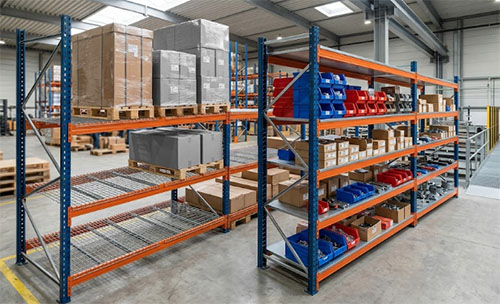
What Is Wire Decking?
Wire decking consists of welded steel wire mesh panels that rest on rack beams (often featuring a waterfall edge for stability). The grid-like surface has openings of 1 to 2 inches, allowing maximum airflow, light transmission, and visibility through the shelves.
What Is Solid Steel Decking?
Solid steel decking is a continuous flat steel sheet, reinforced with heavy-duty support channels underneath for added strength. The surface is completely smooth and uninterrupted.
4 Key Factors to Help You Decide
1. Load Capacity (UDL)
- Wire Decking: Typically supports 2,000–4,000 lbs per shelf (Uniformly Distributed Load).
- Solid Steel Decking: Supports 5,000–8,000 lbs or more per shelf.
Rule of thumb: Choose solid steel for concentrated heavy loads; choose wire decking for standard palletized inventory.
2. Airflow & Fire Safety Compliance
- Wire Decking: Excellent air circulation makes it ideal for cold storage and fresh produce. Crucially, the mesh allows water from overhead fire sprinklers to pass through to lower shelves, ensuring NFPA fire code compliance.
- Solid Steel Decking: Blocks both airflow and water flow, which may require additional lower-level sprinkler systems to meet warehouse safety regulations.
3. Cleaning & Spill Containment
- Solid Steel Decking: Superior for fluid handling. Spills stay on the smooth surface and can be wiped away easily. It also prevents chemical or oil leaks from contaminating products on lower racks.
- Wire Decking: Harder to clean thoroughly, and liquid spills will drip straight down through the wire grid.
4. Small Parts & Loose Storage
- Solid Steel Decking: Keeps small items (nuts, bolts, unpalletized cartons) securely on the surface and provides flat support for bins, totes, and dividers.
- Wire Decking: Small parts or loose items will fall through the wire gaps unless placed on pallets or in large containers.
Comparison at a Glance
| Feature / Factor | Wire Mesh Decking | Solid Steel Decking |
|---|---|---|
| Load Capacity (UDL) | Up to 4,000 lbs / shelf | Up to 8,000+ lbs / shelf |
| Air Circulation | Excellent | None |
| Fire Sprinkler Access | Passes through (Code compliant) | Blocks water flow |
| Cleaning & Maintenance | Difficult | Quick & easy |
| Small Parts Storage | No (Requires containers) | Yes (Direct placement) |
| Initial Cost | Lower | Higher |
Which One Should You Choose?
Choose Wire Decking if:
- You primarily store standard pallets or large cartons.
- Ventilation, air circulation, or cold storage is required.
- Fire safety and sprinkler compliance are top priorities.
- You want a cost-effective, easy-to-install (drop-in) decking solution.
Choose Solid Steel Decking if:
- You store small, loose items, bins, or unpalletized parts.
- You handle chemicals, oils, or liquids requiring spill containment.
- Extremely heavy weight capacities are needed per level.
- Quick, hygienic cleaning is essential for your facility.
Ready to Upgrade Your Storage System?
At our factory, we manufacture both wire mesh and solid steel decking in various sizes, gauges, and structural designs—finished with durable epoxy powder coating for long-lasting rust resistance.
Not sure which surface fits your operation best?
Tell us your product types, average weight per shelf, and warehouse environment—our engineering team will recommend the ideal racking solution based on your actual operational needs, not just price.