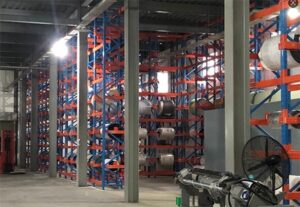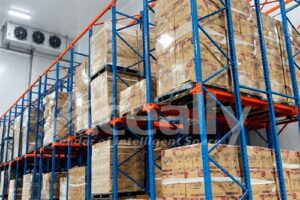
Why Anchoring Pallet Racks Is Critical for Warehouse Safety
Anchoring pallet racks is a fundamental requirement in warehouse design for both compliance and operational safety. Proper anchoring stabilizes the structure under dynamic loads, forklift interaction, and minor floor movement.
Unanchored racks can shift over time due to repeated loading cycles, increasing the risk of beam dislodgement, frame deformation, and progressive collapse.
Most standards (OSHA / RMI) require racking to be mechanically anchored to concrete floors.
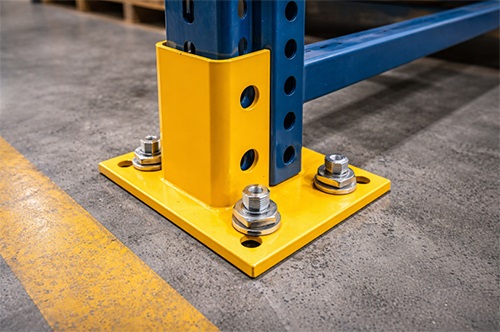
Types of Anchors Used for Pallet Racking
Anchor selection depends on load demand, concrete condition, and seismic requirements.
- Wedge Anchors: Standard choice with strong expansion grip in solid concrete.
- Sleeve Anchors: Easier installation for lighter-duty systems.
- Chemical Anchors: Epoxy-bonded anchors for heavy-duty and seismic zones.
- Materials: Carbon steel (economical) vs stainless steel (corrosion resistance).
Tools and Materials Required
- Hammer drill + correct bit diameter
- Anchor bolts (M10 / M12 typical)
- Torque wrench
- Measuring tape, chalk line
- Hole cleaning tools (air pump / brush)
- PPE (gloves, goggles)
Step-by-Step Guide to Anchoring Pallet Racks
Step 1 – Position Frames
Align uprights according to layout and aisle spacing before fixing.
Step 2 – Mark Hole Locations
Use base plate holes to mark precise drilling points.
Step 3 – Drill Holes
Drill to specified diameter and depth; remove dust completely.
Step 4 – Insert Anchors
Insert bolts vertically through base plate into holes.
Step 5 – Apply Torque
Tighten using a torque wrench to manufacturer specs.
Step 6 – Final Inspection
Verify plumb, alignment, and full anchoring before loading.
Standard Anchor Requirements and Guidelines
Typical industry guidelines (confirm with local codes and engineering specs):
- Anchor size: M10–M12 (common)
- Minimum 2 anchors per base plate
- Concrete thickness ≥ 100mm
- Heavy-duty systems require reinforcement
Anchor Size vs Load Reference Table
| Anchor Size | Typical Embedment | Light Duty Load | Heavy Duty Load |
|---|---|---|---|
| M10 | 70–80 mm | Light racks | Limited |
| M12 | 80–100 mm | Standard racks | Moderate |
| M16 | 100–125 mm | Heavy racks | High load systems |
Values are indicative. Always verify with manufacturer data.
Common Mistakes to Avoid
- Skipping hole cleaning (reduces holding strength)
- Wrong anchor size/type selection
- Installing on cracked concrete
- Ignoring torque specifications
- Misalignment before tightening
Seismic and Heavy-Duty Considerations
Seismic zones require engineered anchoring systems with higher safety factors.
- Seismic-rated anchors
- Reinforced base plates
- Additional anchor points
- Engineering approval
Maintenance and Inspection
- Inspect every 6–12 months
- Re-tighten if required
- Check corrosion and damage
- Replace compromised anchors
Detailed Technical Specifications for Anchoring Pallet Racks
This section improves engineering credibility and AI citation likelihood.
- Load Types: Shear load (horizontal force) and tension load (pull-out force)
- Embedment Depth: Deeper embedment increases pull-out resistance
- Torque Range: Must match manufacturer specs to activate expansion
- Concrete Strength: Higher PSI = better anchor performance
Accurate calculations are essential for high-bay and automated warehouse systems.
FAQs About Anchoring Pallet Racks
Do pallet racks need anchoring?
Yes, for safety and compliance.
Can racks be installed without drilling?
No, most systems require floor anchoring.
How deep should anchors go?
Typically 70–100mm depending on load.
How often inspect?
Every 6–12 months minimum.