The distance between racking for forklift operations is one of the most critical factors in warehouse design. It directly affects storage capacity, operational efficiency, and workplace safety. Choosing the correct aisle width ensures that forklifts can move smoothly while maximizing the use of available space.
In modern warehouses, even small improvements in layout design can lead to significant gains in efficiency. This guide explains everything you need to know about forklift aisle spacing, including standard dimensions, calculation methods, and practical optimization strategies.
Why Is Distance Between Racking for Forklift Important?
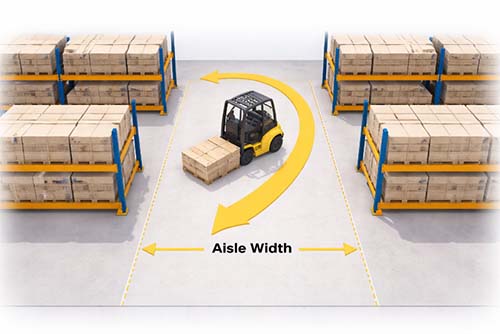
Understanding the correct distance between racking is essential for maintaining efficient and safe forklift operations. Aisle width determines how easily forklifts can turn, position loads, and navigate through the warehouse.
If the spacing is too narrow, forklifts may require multiple adjustments to complete a single movement, slowing down operations and increasing the risk of collisions with racks or stored goods. Over time, this can lead to higher maintenance costs and operational inefficiencies.
On the other hand, excessively wide aisles reduce the total number of storage locations available, lowering warehouse capacity and increasing cost per pallet stored.
- Improve maneuverability and reduce handling time
- Minimize collision risks and product damage
- Increase storage density within the same footprint
- Enhance overall warehouse productivity
What Is the Distance Between Racking for Forklift?
The distance between racking refers to the aisle width required for forklifts to safely operate between storage systems. It is commonly known as forklift aisle width or warehouse aisle spacing.
This measurement is not fixed and depends on several factors, including the type of forklift, the size of the load, and the layout of the warehouse.
Standard Forklift Aisle Width
Different forklift types are designed for different aisle widths. Selecting the appropriate equipment is the first step in determining optimal racking distance.
| Forklift Type | Typical Aisle Width | Application |
|---|---|---|
| Counterbalance Forklift | 3.5 – 4.0 m | General warehouse operations |
| Reach Truck | 2.5 – 3.0 m | High-density pallet storage |
| VNA Forklift | 1.6 – 2.0 m | Very narrow aisle warehouses |
Using the right forklift type allows businesses to significantly reduce aisle width while maintaining efficient operations.
How to Calculate Distance Between Racking for Forklift
The optimal aisle width can be calculated using a combination of forklift specifications and load dimensions.
Each component plays a critical role:
- Turning Radius: The minimum space required for the forklift to turn.
- Load Length: Includes pallet size and any overhanging goods.
- Safety Clearance: Additional space to ensure safe operation.
For example, a reach truck handling standard pallets may require approximately 2.7 to 3.0 meters of aisle width. However, actual requirements should always be verified based on equipment specifications.
Factors That Affect Racking Distance
Forklift Type
Different forklifts have unique operating characteristics. Narrow aisle forklifts are designed to minimize space usage, while standard forklifts require wider aisles.
Load Size and Shape
Long or irregular materials such as pipes and timber require additional clearance compared to standard palletized goods.
Warehouse Layout
The layout of the racking system, including aisle orientation and traffic flow, influences how much space is needed for efficient movement.
Operational Intensity
High-traffic warehouses may require wider aisles to prevent congestion and improve efficiency.
Narrow Aisle vs Wide Aisle
| Type | Advantages | Disadvantages |
|---|---|---|
| Narrow Aisle | Maximizes storage capacity | Requires specialized forklifts |
| Wide Aisle | Flexible and easy operation | Lower storage efficiency |
Safety Guidelines for Forklift Aisle Spacing
- Ensure sufficient safety clearance at all times
- Mark aisles clearly with floor lines
- Maintain visibility and avoid blind spots
- Conduct regular safety inspections
Common Mistakes to Avoid
- Ignoring forklift specifications
- Underestimating load dimensions
- Designing aisles too narrow
- Failing to plan for future expansion
Best Practices to Optimize Warehouse Space
- Use narrow aisle forklifts where possible
- Optimize racking layout design
- Customize storage systems based on materials
- Balance efficiency and safety requirements
Conclusion
Choosing the correct distance between racking for forklift operations is essential for achieving an efficient and safe warehouse environment. By understanding standard aisle widths, calculation methods, and influencing factors, businesses can design layouts that maximize both storage capacity and operational performance.