Understanding Wire Mesh Containers and Steel Bins
Wire mesh containers and steel bins are both essential storage solutions used in warehouses, manufacturing facilities, and logistics operations. They are designed to improve storage efficiency, simplify material handling, and maximize available space.
Both options share several important characteristics. They are made from durable steel materials, compatible with forklifts or handling equipment, and designed to support stacking for better vertical storage utilization.
What Are Wire Mesh Containers?
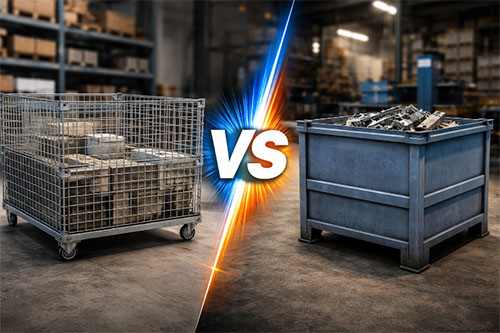
Wire mesh containers are storage units constructed from welded steel wire, forming an open-grid structure. This design allows operators to easily see the contents, improving picking speed and inventory accuracy.
They are typically used in environments where visibility and flexibility are important, such as e-commerce warehouses, retail distribution centers, and automotive parts storage.
- Open design for instant inventory visibility
- Good airflow to reduce moisture and dust buildup
- Foldable structure for space-saving storage
- Optional casters for easy manual movement
What Are Steel Bins?
Steel bins are solid or semi-enclosed containers made from steel plates. They are engineered for heavy-duty applications and are commonly used to store dense, bulk, or loose materials.
Unlike wire mesh containers, steel bins focus on strength and durability, making them suitable for demanding industrial environments such as manufacturing plants and construction material storage.
- Solid panels for maximum load capacity
- High durability in harsh environments
- Stackable for efficient vertical storage
- Designed for forklift handling
Key Differences Between Wire Mesh and Steel Bins
Visibility and Inventory Control
Wire mesh containers provide full visibility of stored items, allowing workers to quickly identify contents without opening the container. This significantly improves picking efficiency and reduces errors.
Steel bins, on the other hand, are enclosed and typically require labeling or manual checking, which can slow down operations in fast-paced environments.
Load Capacity and Strength
Steel bins are designed for heavy-duty applications and can support significantly higher loads than wire mesh containers. They are ideal for storing metal parts, bulk materials, and industrial components.
Wire mesh containers are better suited for light to medium-duty loads where flexibility is more important than maximum strength.
Ventilation and Moisture Control
The open structure of wire mesh containers allows air to circulate freely, helping to prevent moisture buildup and reducing the risk of corrosion or mold.
Steel bins provide limited ventilation, which may require additional considerations in humid or temperature-sensitive environments.
Mobility and Handling
Wire mesh containers are often designed for flexible handling and may include casters, making them easy to move manually in picking areas.
Steel bins are typically heavier and are primarily moved using forklifts, making them more suitable for static storage rather than frequent relocation.
Space Efficiency
Many wire mesh containers are foldable, allowing them to be collapsed when not in use, which helps save valuable warehouse space.
Steel bins maintain a fixed structure, which may take up more space but provides greater stability when stacked.
Quick Comparison
| Feature | Wire Mesh Containers | Steel Bins |
|---|---|---|
| Visibility | High | Low |
| Load Capacity | Medium | High |
| Ventilation | Excellent | Limited |
| Mobility | Flexible (optional wheels) | Forklift-based |
| Space Saving | Foldable | Fixed |
Pros and Cons
Wire Mesh Containers
- Excellent visibility improves picking speed
- Foldable design reduces storage space
- Good ventilation for sensitive goods
- Lower load capacity compared to steel bins
- Not ideal for very small or loose materials
Steel Bins
- High load capacity for heavy-duty storage
- Durable and long-lasting
- Suitable for bulk materials
- Limited visibility
- Heavier and less flexible to move
Common Use Cases
| Industry | Recommended Solution |
|---|---|
| E-commerce & Retail | Wire Mesh Containers |
| Automotive Parts | Wire Mesh Containers |
| Manufacturing | Steel Bins |
| Agriculture | Steel Bins |
| Cold Storage | Wire Mesh Containers |
Using Both Together for Better Efficiency
Many warehouses benefit from using both wire mesh containers and steel bins together. This hybrid approach allows businesses to take advantage of both flexibility and strength.
- Wire mesh containers for picking and sorting areas
- Steel bins for bulk and heavy-duty storage
Factors to Consider When Choosing
- Load weight and material type
- Warehouse environment (humidity, temperature)
- Handling method (manual vs forklift)
- Space availability and storage density
Frequently Asked Questions
Are wire mesh containers strong enough for heavy loads?
They are suitable for medium-duty applications but may not be ideal for extremely heavy industrial loads.
Do steel bins rust over time?
Steel bins can resist corrosion if treated with powder coating or galvanization.
Which option is better for warehouse efficiency?
Wire mesh containers are generally better for fast-moving operations due to their visibility and flexibility.
Can steel bins be used for small parts?
They can be used with internal dividers, but are not as convenient as wire mesh containers for small items.
Are wire mesh containers suitable for cold storage?
Yes, their ventilation makes them ideal for environments where airflow is important.
Conclusion
Choosing between wire mesh containers and steel bins depends on your operational requirements, including load capacity, handling method, and storage environment.
In many cases, combining both solutions can create a more efficient and flexible warehouse system.