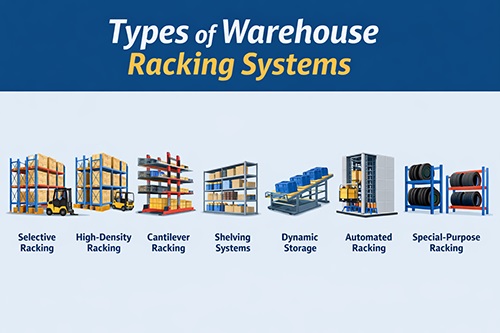
We can divide warehouse racking systems into several major categories: selective racking, high-density racking, cantilever racking, shelving systems, dynamic storage systems, automated racking, and special-purpose racking. Each type is designed to meet specific storage needs, whether it’s maximizing warehouse space, improving picking efficiency, or supporting automated operations. Understanding these categories is essential for choosing the right system that ensures safety, efficiency, and cost-effective warehouse management.
1. Selective Racking
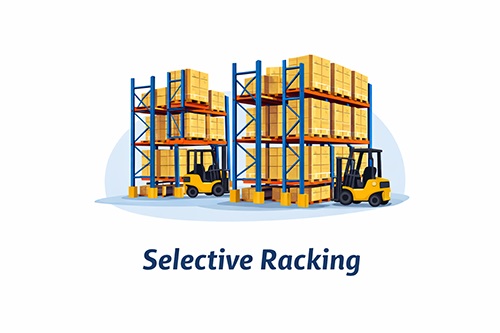
We can divide selective racking into subtypes that provide direct access to every pallet: standard selective pallet racking, wide aisle racking, and narrow aisle/VNA racking. This category is ideal for warehouses with a wide variety of SKUs and frequent stock rotation.
-
Standard Selective Pallet Racking: Adjustable beams store pallets one-deep, offering full accessibility and compatibility with standard forklifts.
-
Wide Aisle Pallet Racking: Optimized for conventional forklifts, prioritizing access over storage density.
-
Narrow Aisle / Very Narrow Aisle (VNA): Reduces aisle width to increase storage capacity, requiring reach trucks or turret trucks.
2. High-Density Racking
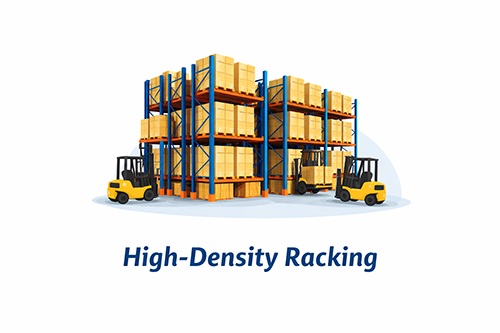
We can divide high-density racking into subtypes designed to maximize storage space: drive-in & drive-through racking, push back racking, pallet flow racking, and double deep racking. These systems reduce aisle space and store multiple pallets deep, ideal for bulk storage and uniform products.
-
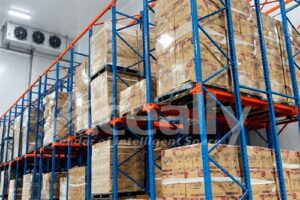
Drive-In & Drive-Through Racking: Forklifts drive into the rack structure; LIFO for drive-in, FIFO for drive-through.
-
Push Back Racking: Pallets move backward on rails when new pallets are loaded, increasing density and picking speed.
-
Pallet Flow Racking: Gravity-based lanes move pallets from loading to picking side, supporting FIFO operations.
-
Double Deep Racking: Two pallets deep storage, requiring reach trucks for access.
3. Cantilever Racking
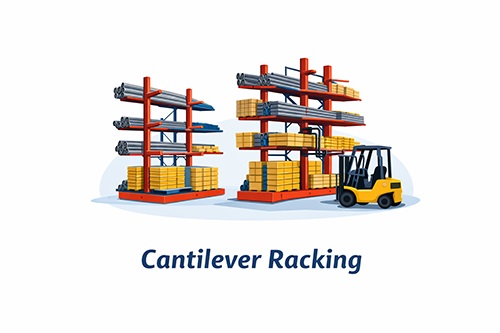
We can divide cantilever racking into subtypes for storing long, bulky, or irregular loads: single-sided, double-sided, and light/medium/heavy-duty cantilever.
-
Single-Sided Cantilever: Wall-mounted or standalone units for one-sided access.
-
Double-Sided Cantilever: Accessible from both sides, ideal for central aisles.
-
Light, Medium, Heavy-Duty: Designed for pipes, lumber, aluminum profiles, and sheet materials.
4. Shelving Systems
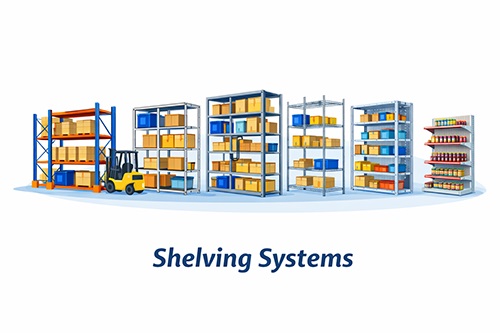
We can divide shelving systems into subtypes suitable for manual picking and non-palletized goods: longspan shelving, boltless/rivet shelving, steel shelving, wire shelving, slotted angle shelving, and supermarket shelving. These systems handle cartons, small items, and other goods that do not require forklifts.
-
Longspan Shelving: Medium-duty shelving ideal for cartons, boxes, and bulk items, providing flexible storage for warehouses or stockrooms.
-
Boltless / Rivet Shelving: Quick to assemble and easy to reconfigure, these shelves are widely used in warehouses and backrooms for versatile storage solutions.
-
Steel Shelving: Open or closed steel units that offer sturdy, organized storage for various items.
-
Wire Shelving: Chrome wire and adjustable racks that improve visibility and airflow, suitable for retail, warehouse, or industrial use.
-
Slotted Angle Shelving: Modular and adjustable shelving made from slotted steel angles, perfect for workshops, factories, or warehouses where flexibility is required.
-
Supermarket Shelving: Designed for retail display, these shelves allow easy access, product visibility, and configurable layouts to support merchandising needs.
5. Dynamic Storage Systems
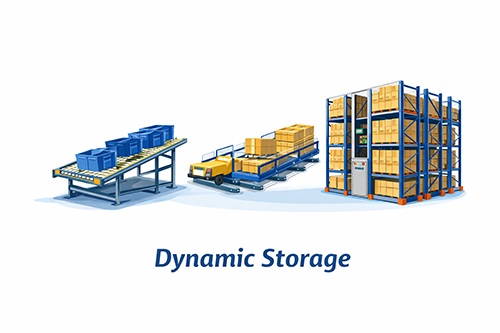
We can divide dynamic storage systems into subtypes that improve picking efficiency: carton flow racking, pallet shuttle racking, and mobile racking systems. These systems often use gravity or semi-automation to move inventory.
-
Carton Flow Racking: Cartons move forward automatically as items are picked, supporting FIFO picking.
-
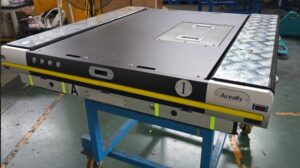
Pallet Shuttle Racking: Radio-controlled shuttles move pallets within storage lanes for semi-automated operation.
-
Mobile Racking Systems: Entire racks move on rails to open aisles only when needed, saving floor space.
6. Automated Racking
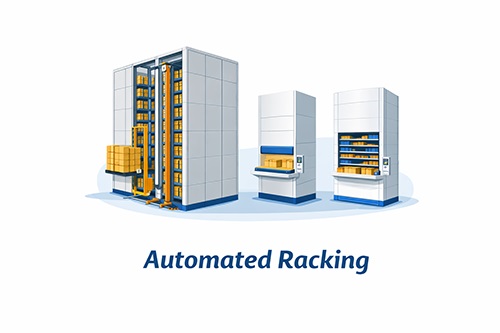
We can divide automated racking systems into subtypes that maximize efficiency: AS/RS (Automated Storage & Retrieval Systems) and vertical storage systems. These systems reduce labor, improve accuracy, and optimize space utilization.
-
AS/RS: Computer-controlled cranes or shuttles store and retrieve pallets or cartons automatically.
-
Vertical Storage Systems: Vertical lift modules (VLMs) and carousels utilize vertical space efficiently.
7. Special-Purpose Racking
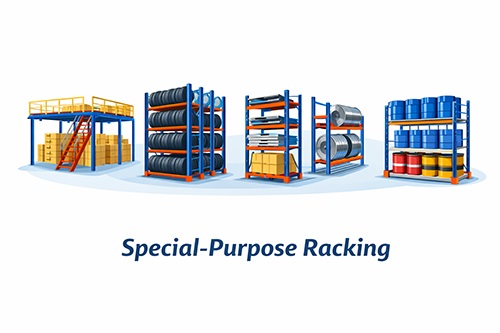
We can divide special-purpose racking into subtypes designed for specific materials or industries: mezzanine racking, tire racking, sheet metal & coil racking, and drum & barrel racking.
-
Mezzanine Racking: Multi-level storage platforms expand vertical warehouse space.
-
Tire Racking: Designed for automotive or industrial tire storage.
-
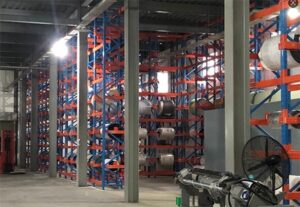
Sheet Metal & Coil Racking: Safe storage for metal sheets and coils.
-
Drum & Barrel Racking: Storage for oil drums, chemicals, or hazardous materials.
Summary: How Many Types of Racking Are There?
We can divide warehouse racking into 7 major categories with 20+ commonly used subtypes. Choosing the right system depends on:
-
Warehouse layout and dimensions
-
Product type, weight, and SKU variety
-
Handling equipment compatibility
-
Inventory rotation method (FIFO or LIFO)
-
Automation and budget considerations
A well-chosen racking system improves safety, efficiency, and long-term ROI.
FAQ
How many types of warehouse racking are there?
There are 7 major categories with over 20 subtypes commonly used in warehouses.
Which racking system is most common?
Selective pallet racking is the most widely used due to its flexibility and accessibility.
Which racking system provides the highest storage density?
Drive-in racking, pallet flow racking, and shuttle racking offer maximum density.
What is the difference between racking and shelving?
Racking is typically for palletized goods handled by forklifts; shelving is for manual storage of smaller items.
Conclusion
We can divide warehouse racking systems into clear categories to match storage needs, operational efficiency, and automation requirements. Understanding these categories helps warehouses make informed decisions that enhance safety, improve throughput, and optimize long-term costs.