
In today’s fast-paced industrial and commercial environments, maximizing every inch of warehouse space has become a strategic necessity. Rising land costs, longer lease terms, and operational disruption make physical expansion increasingly difficult. As a result, many warehouses are turning to a highly effective but often underutilized resource: vertical space.
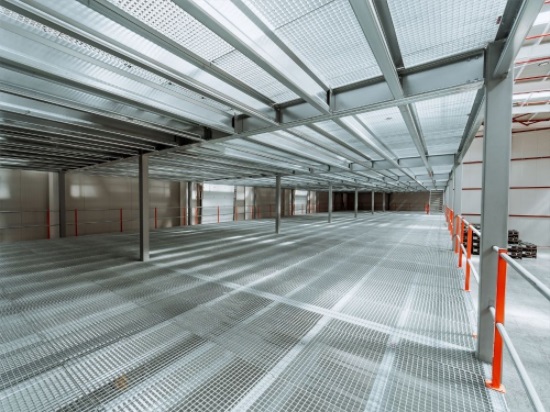
Mezzanine racking systems provide a practical and scalable solution for businesses that require additional storage or operational space without the need for relocation or rebuilding. By adding a structural level within an existing facility, warehouses can significantly increase capacity while maintaining efficient daily operations.
What Is Mezzanine Racking?
A mezzanine racking system is a raised intermediate steel platform installed between the main warehouse floor and the ceiling. Unlike standard shelving or pallet racking, a mezzanine creates a completely new usable level inside the building.
When combined with pallet racking, shelving systems, workstations, or offices, mezzanine racking transforms unused vertical volume into a functional workspace. Depending on the design, it can be used for storage, order picking, assembly, light manufacturing, or administrative purposes.
Why Choose a Mezzanine Racking System?
1. Increase Storage and Operational Space Without Expansion
Most warehouses utilize only a portion of their available height. A properly engineered mezzanine racking system can double or even triple usable floor area without increasing the building footprint.
Common applications include:
-
Additional pallet racking or shelving for inventory
-
Order picking and packing zones
-
Assembly and kitting areas
-
Offices, locker rooms, or staff facilities
-
Retail display or showroom space
This approach allows businesses to scale operations while avoiding costly construction or relocation.
2. Improve Workflow and Warehouse Organization
Mezzanine racking systems enable vertical zoning of warehouse activities. Fast-moving products can remain on the ground level for quick access, while slower-moving inventory, packaging operations, or administrative functions are placed on upper levels.
This vertical separation helps to:
-
Reduce congestion on the warehouse floor
-
Shorten travel distances for staff
-
Improve picking accuracy and efficiency
-
Create a safer and more organized work environment
3. Faster Return on Investment Compared to Facility Expansion
Expanding a warehouse or moving to a new facility involves significant capital investment, long timelines, and higher ongoing operating costs. In contrast, a mezzanine racking system is a cost-effective alternative that delivers additional space within the existing building.
Because installation can often be completed with minimal disruption, many businesses achieve a faster return on investment while preserving operational continuity.
4. Engineered Strength, Safety, and Compliance
Industrial mezzanine racking systems are designed for far more than simple storage. They are engineered using heavy-duty structural steel to support racking systems, palletized loads, equipment, and continuous foot traffic.
Key safety and design considerations include:
-
Guardrails, handrails, and toe boards
-
Industrial staircases and controlled access points
-
Decking options such as steel plate, bar grating, or particle board
-
Design aligned with applicable building and safety codes
Load capacity, column spacing, beam deflection, and access requirements are evaluated during the design phase to ensure long-term structural stability and safe operation.
5. Modular and Future-Ready Design
Business needs change over time, and mezzanine racking systems are designed with flexibility in mind. Many systems are modular, allowing for expansion, reconfiguration, or relocation as operational requirements evolve.
Whether a warehouse requires a single-level platform or a multi-tier mezzanine integrated with racking and conveyors, mezzanine systems can be adapted to support both current operations and future growth.
Common Applications Across Industries
Mezzanine racking systems are widely used across a range of industries:
-
Logistics and Warehousing
Add high-density storage above staging or cross-docking areas. -
Manufacturing
Create elevated assembly platforms or parts storage zones. -
Distribution Centers
Build multi-level picking and fulfillment areas. -
Retail and Wholesale
Add overhead stockrooms or expand showroom capacity.
Industry Insight from Aceally
Based on Aceally’s experience working with warehouses and industrial facilities, one challenge appears repeatedly: vertical space is available, but rarely used efficiently. Many facilities reach capacity limits while large volumes of air remain unused above the floor.
Mezzanine racking systems are often introduced when warehouses need immediate capacity growth but are not ready—or able—to expand their physical footprint. When properly designed, they offer a long-term solution that balances efficiency, safety, and scalability.
Frequently Asked Questions About Mezzanine Racking Systems
Is a mezzanine racking system suitable for existing warehouses?
Yes. Mezzanine racking systems are commonly installed in existing facilities and are designed around ceiling height, floor load capacity, and operational layout.
How much weight can a mezzanine racking system support?
Load capacity depends on design requirements. Industrial mezzanine systems can be engineered to support shelving, pallet racking, machinery, and continuous foot traffic.
Do mezzanine racking systems require permits or approvals?
In many regions, permits and compliance with building and safety codes are required. It is important to work with an experienced manufacturer during the design phase.
Post time: Dec-15-2025