
Pallets are one of the most fundamental yet underestimated components in modern warehousing and logistics systems. From manual handling to fully automated storage and retrieval systems, pallet standards directly affect storage efficiency, safety, transportation cost, and regulatory compliance.
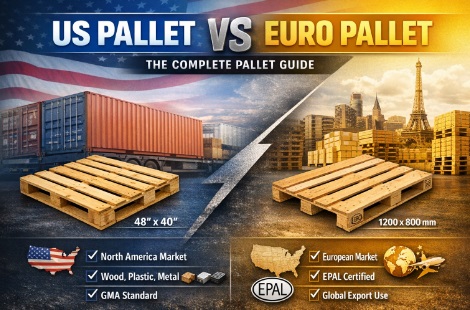
Among the most widely used pallet types worldwide, US pallets and Euro pallets are often compared due to their different dimensions, standards, and regional dominance. Understanding the differences between these two pallet systems is essential for businesses operating across international markets.
This guide provides a professional, experience-based comparison of US pallets vs Euro pallets, helping warehouse operators, logistics managers, and procurement teams make informed decisions.
What Is a US Pallet?
A US pallet, commonly known as the GMA pallet, follows the standard size of 48 × 40 inches (1219 × 1016 mm). It is the most widely used pallet type in North America and is deeply integrated into U.S. warehouse infrastructure.
US pallets are typically manufactured from wood, though plastic and steel options are also used for specific industries. Their design prioritizes versatility, making them compatible with forklifts, pallet jacks, and most selective pallet racking systems.
Common applications include:
-
Retail and FMCG distribution centers
-
Manufacturing facilities
-
Third-party logistics (3PL) warehouses
-
Food and beverage supply chains
The US pallet’s widespread adoption ensures high availability and relatively lower costs within the North American market.
What Is a Euro Pallet (EUR / EPAL Pallet)?
The Euro pallet, officially regulated by EPAL (European Pallet Association), has a standard size of 1200 × 800 mm. It is the backbone of palletized logistics across Europe and is also widely used in the Middle East and international export projects.
Euro pallets are manufactured under strict specifications, including material quality, structural design, and repair standards. Each pallet is traceable and inspected, ensuring consistency and reliability across supply chains.
Typical use cases include:
-
European logistics hubs
-
Export-oriented warehouses
-
Automated and high-density storage systems
-
Industries with strict compliance requirements
US Pallet vs Euro Pallet: Key Differences
The most obvious difference between US pallets and Euro pallets lies in their dimensions, but the impact goes far beyond size.
US pallets offer a wider surface area, making them suitable for bulk goods and retail packaging optimized for the North American market. Euro pallets, with a narrower footprint, provide better space utilization in trucks and containers commonly used in Europe.
Structural design also varies. Euro pallets are generally heavier and more rigid, while US pallets emphasize flexibility and cost efficiency. These differences directly influence racking compatibility, load stability, and transportation efficiency.
Load Capacity & Structural Design Comparison
Both pallet types are designed for heavy-duty applications, but their load performance differs based on structure and usage conditions.
US pallets typically perform well in dynamic operations with frequent forklift handling and high turnover. Euro pallets, on the other hand, excel in static storage and high-density racking, where consistent load distribution is critical.
From a racking perspective, pallet choice affects:
-
Beam spacing
-
Rack depth configuration
-
Load calculation and safety margins
Using mismatched pallet sizes can significantly reduce warehouse safety and storage efficiency.
Compliance, Regulations & Export Considerations
International logistics requires strict adherence to regulations, particularly for wooden pallets.
Both US pallets and Euro pallets must comply with ISPM 15 regulations for heat treatment or fumigation when used for export. However, Euro pallets offer an advantage due to their standardized inspection and certification system under EPAL.
For companies involved in cross-border shipping, choosing the right pallet can reduce customs delays, compliance risks, and long-term operational costs.
Cost, Availability & Lifecycle Comparison
From a cost perspective, US pallets are generally more affordable within North America due to mass production and widespread circulation. Euro pallets often have a higher initial cost but compensate with longer service life and standardized repair systems.
When evaluating pallet options, it is important to consider total cost of ownership (TCO) rather than purchase price alone. Factors such as durability, reuse cycles, and availability of replacements play a critical role in long-term efficiency.
Which Pallet Should You Choose?
The right pallet depends on your operational environment:
-
Choose US pallets if your primary market is North America and your warehouse system is optimized for 48 × 40-inch pallets.
-
Choose Euro pallets if you operate in Europe, the Middle East, or rely heavily on export logistics.
-
For automated or high-density warehouses, pallet consistency and dimensional accuracy become especially important.
In some international projects, businesses adopt custom pallet solutions designed to match specific racking systems and transportation requirements.
Industry Use Cases: Real-World Applications
In North American retail distribution centers, US pallets dominate due to compatibility with standardized packaging and racking layouts. In contrast, European logistics hubs rely on Euro pallets to maximize container utilization and comply with strict quality standards.
For global operations, many companies maintain dual pallet systems or use transfer pallets to bridge regional differences.
Expert Insights: Pallet Selection from a Warehouse Racking Perspective
From a warehouse racking manufacturer’s viewpoint, pallet selection should never be isolated from racking design. Incorrect pallet size or inconsistent quality can lead to beam damage, load instability, and safety risks.
Aligning pallet specifications with racking systems ensures:
-
Higher storage density
-
Improved safety performance
-
Longer service life for both pallets and racks
Conclusion: Making the Right Pallet Choice
US pallets and Euro pallets each serve their markets effectively, but neither is universally better. The best choice depends on geography, warehouse design, compliance requirements, and long-term operational goals.
By understanding these differences, businesses can optimize storage efficiency, reduce risk, and build more resilient supply chains.
Post time: Jan-04-2026