“How high can you stack pallets in a warehouse?” is one of the most common questions in warehouse planning.
The short answer is simple:
there is no single standard height.
The maximum stacking height depends on your pallets, products, warehouse conditions, handling equipment, and whether you use a warehouse storage rack system.
This guide explains the real factors that determine how high pallets can be stacked safely and efficiently in modern warehouses.
How High Can You Stack Pallets in a Warehouse?
In practice, pallet stacking height is not defined by a universal rule.
It is determined by a combination of:
-
pallet strength
-
product stability
-
floor conditions
-
forklift capability
-
racking system design
Without a proper storage system, stacking height is usually limited for safety reasons.
With a properly engineered pallet racking system, vertical space can be used much more effectively.
Why Pallet Stacking Height Is Not a Fixed Number
Every warehouse operates under different conditions.
A warehouse with light cartons, strong pallets, and modern reach trucks can stack much higher than a warehouse handling unstable or deformable loads.
Building height, sprinkler clearance, lighting, and ventilation systems also affect how high pallets can be stored.
For this reason, stacking height must always be evaluated as a site-specific design decision.
Key Factors That Determine Pallet Stacking Height
Pallet Load Capacity
Different pallets have different load ratings.
Wooden pallets, plastic pallets, and steel pallets behave very differently under load.
It is also important to distinguish between:
-
static load capacity
-
dynamic load capacity
Stacking height must be based on the real working load, not the theoretical maximum.
Product Stability and Packaging
The shape and packaging of the goods have a major influence on how high pallets can be stacked.
Cartons, bags, drums, and soft-packed products do not perform the same when stacked vertically.
Products that deform easily or shift during handling significantly reduce safe stacking height.
Warehouse Floor Conditions
High stacking requires a flat and properly designed concrete floor.
Uneven floors or insufficient bearing capacity increase the risk of pallet tilting and rack misalignment.
Floor quality becomes even more critical in high-bay and high-density warehouse projects.
Forklift and Handling Equipment Capability
The lifting height and residual capacity of forklifts directly limit stacking height.
As lift height increases, forklift capacity decreases.
Reach trucks, very narrow aisle trucks, and counterbalance forklifts all have different performance characteristics, which must be considered during layout design.
Whether You Use a Warehouse Storage Rack System
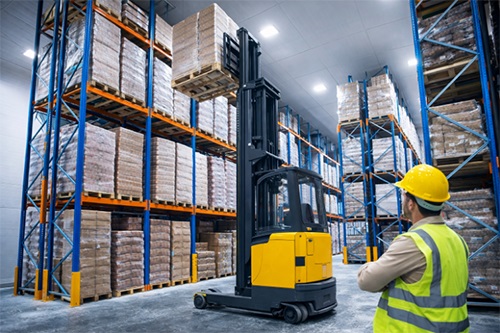
The biggest difference in stacking height comes from whether pallets are stored on the floor or on a racking system.
Floor stacking relies entirely on pallet and product stability.
Warehouse storage racks provide controlled support, alignment, and protection, allowing pallets to be stored safely at much higher elevations.
How High Can Pallets Be Stacked Without Racking?
When pallets are stacked directly on the floor, the stacking height is usually very limited.
In most operations, floor stacking is restricted to a small number of pallet layers.
The main limitations are:
-
load deformation
-
pallet compression
-
poor stability
-
difficulty in access
Floor stacking may appear economical, but it often reduces storage density and creates higher damage and safety risks.
How High Can Pallets Be Stacked With Pallet Racking?
When pallets are stored on properly designed pallet racking systems, stacking height is mainly determined by:
-
building clear height
-
rack structural design
-
handling equipment reach
-
fire protection requirements
Modern warehouse racking systems can be designed for high-bay applications where vertical space is fully utilized.
In this case, stacking height becomes a result of engineering design rather than trial-and-error operation.
How Different Racking Systems Affect Stacking Height
Selective Pallet Racking
Selective pallet racking is the most flexible system.
It can be designed for both low and high warehouse buildings.
The system provides full pallet access and adapts easily to different pallet heights and product types.
Its maximum height is primarily limited by building height and forklift reach.
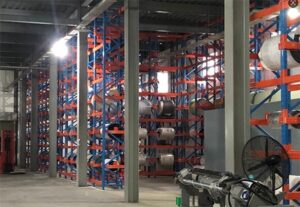
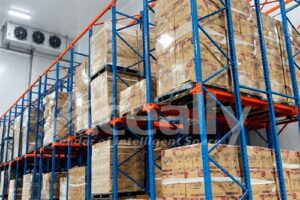
Drive-In Pallet Racking
Drive-in racking is used for high-density storage of similar products.
Because forklifts drive into the racking lanes, the system must be designed with stricter structural tolerances and protection measures.
Drive-in racking can be built to considerable heights, but forklift operation and load stability become increasingly critical at higher levels.
Double deep pallet racking is a high-density storage system where pallets are stored two positions deep on each side of the aisle.
Compared with standard selective pallet racking, this system reduces the number of aisles and increases storage density without significantly increasing the overall rack height.
From a stacking height perspective, double deep racking helps improve vertical space utilization while keeping a relatively simple rack structure.
The achievable stacking height is mainly determined by the building clear height and the lifting capability of reach trucks equipped with double-deep or telescopic forks.
Double deep pallet racking is commonly used in warehouses with medium throughput and multiple pallets of the same SKU stored in the same location.
Because the rear pallet cannot be accessed directly, proper inventory strategy is important when designing stacking height and daily operations.
Push Back Racking
Push back racking allows multiple pallets to be stored in depth on each level.
The structural design of the cart and rail system influences how many levels can be safely built.
Push back racking is commonly used when higher storage density and reasonable throughput are both required.
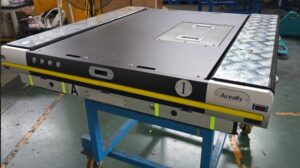
Radio Shuttle Racking
Radio shuttle racking is particularly suitable for high stacking height in high-density warehouses.
Forklifts do not need to enter the storage lanes.
The shuttle handles pallet movement inside the racking structure.
This significantly reduces the risk of rack impact and allows deeper and higher lane designs.
For warehouses planning future automation, radio shuttle racking provides a practical transition solution.
Do Regulations and Safety Rules Limit Stacking Height?
Yes.
Local building codes, fire protection regulations, and internal safety standards all influence how high pallets can be stored.
In many regions, sprinkler clearance, rack configuration, and aisle width are strictly regulated.
Insurance companies and third-party safety audits may also impose operational limits on stacking height.
For this reason, racking height should always be verified against local compliance requirements.
Is Higher Stacking Always More Efficient?
Not necessarily.
Higher stacking improves space utilization, but it may reduce operational speed and increase equipment costs.
Higher lift trucks are more expensive and slower to operate.
Maintenance, training, and safety management requirements also increase as stacking height rises.
The most efficient warehouse is not the one with the highest racks, but the one with the best balance between height, throughput, and operating cost.
How to Determine the Most Reasonable Pallet Stacking Height for Your Warehouse
A practical stacking height should be determined by evaluating:
-
warehouse dimensions and clear height
-
pallet and product specifications
-
daily throughput and order patterns
-
handling equipment selection
-
future expansion or automation plans
Professional warehouse layout and racking design help identify the optimal height instead of simply maximizing vertical space.
Common Risks of High Stacking and How to Reduce Them
High stacking introduces several operational risks.
The most common risks include:
-
pallet instability
-
rack impact by forklifts
-
falling goods
-
structural overload
These risks can be reduced through:
-
properly engineered racking systems
-
rack protection and column guards
-
clearly defined operating procedures
-
regular inspection and maintenance
Good design and disciplined operation are both essential.
Typical Pallet Stacking Scenarios in Real Warehouse Projects
In standard distribution warehouses, selective pallet racking is commonly used to achieve a balanced stacking height with high accessibility.
In high-density storage projects, drive-in or push back racking is often selected to increase pallet positions without expanding the building footprint.
For high-throughput and cold or high-value environments, radio shuttle racking is increasingly applied to achieve both high stacking height and safer operations.
Frequently Asked Questions
How many pallet layers can be stacked without racking?
There is no universal number.
It depends on pallet strength, product stability, and safety policy.
In most professional warehouses, floor stacking is kept very limited.
What mainly limits stacking height when pallet racking is used?
The main limitations are building clear height, forklift reach capacity, and fire protection requirements.
Is pallet stacking height different in cold storage warehouses?
Cold storage warehouses often apply higher-density racking systems to maximize expensive refrigerated space.
However, material selection, floor conditions, and safety margins must be carefully considered.
Does a high stacking warehouse always require automation?
No.
Many high stacking warehouses operate successfully with manual handling equipment.
Automation becomes attractive when throughput, labor efficiency, and long-term operating stability are key objectives.
Practical Experience from Real Warehouse Projects
In real warehouse projects, stacking height is usually determined during the racking layout and equipment selection stage.
As a racking system manufacturer and solution provider, we have supported warehouses handling food, industrial parts, and fast-moving consumer goods, where stacking height had to be optimized based on building clearance, pallet weight, and forklift performance.
In many projects, the key challenge is not how high the racks can be built, but how to balance stacking height with operating speed, safety margins, and future expansion plans.
This is especially important in high-density systems such as drive-in racking and radio shuttle racking, where layout accuracy and equipment coordination directly affect long-term warehouse performance.
Conclusion
There is no single answer to the question, “how high can you stack pallets in a warehouse.”
The real limit is defined by engineering design, operational requirements, and safety standards.
By selecting the right warehouse storage rack system and designing the layout correctly, warehouses can achieve safe and efficient stacking height while supporting long-term growth and future automation.